AI vs Manual Macro Tracking for Multi-Ingredient Meals
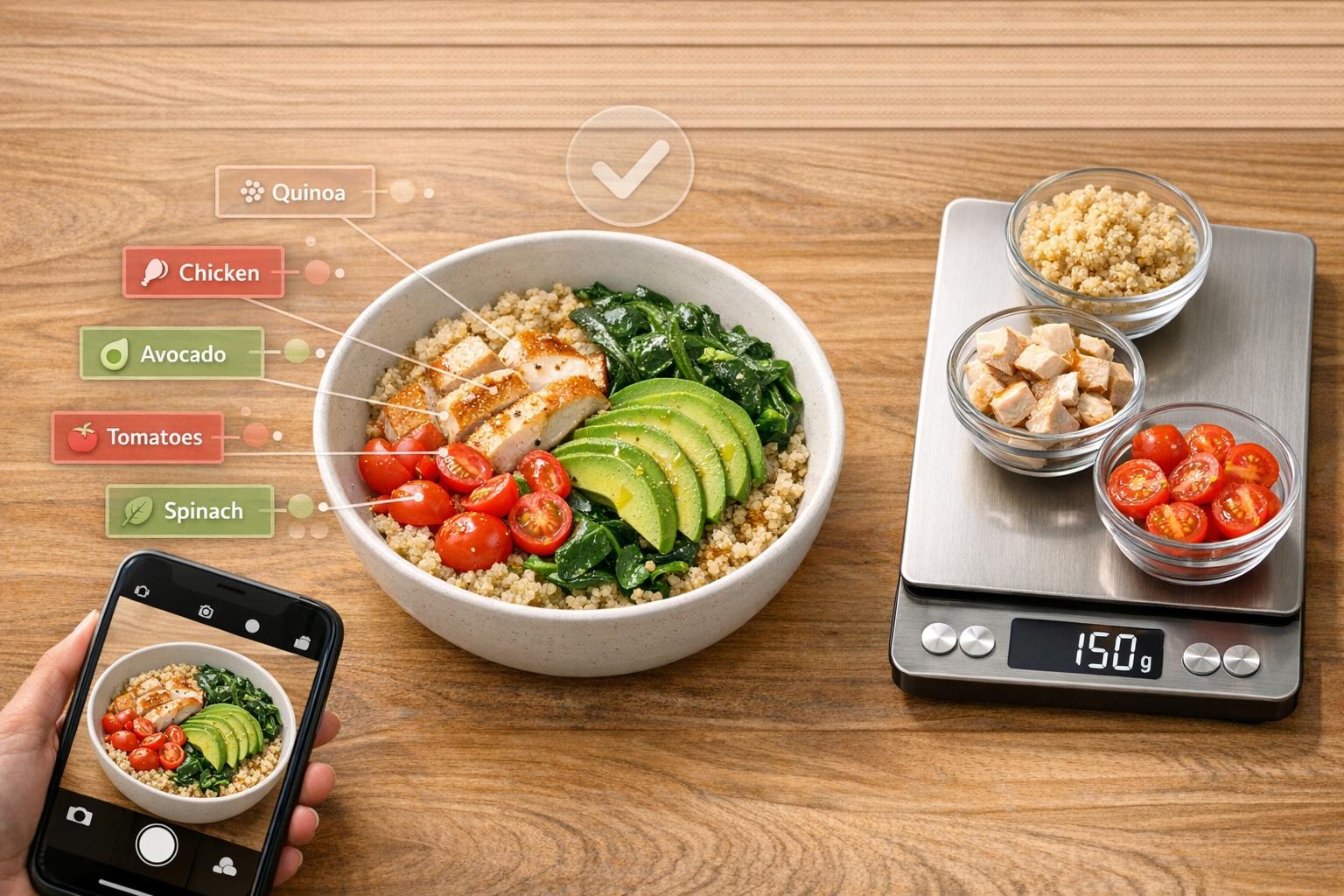
AI vs Manual Macro Tracking for Multi-Ingredient Meals
Tracking macros for meals with multiple ingredients can be challenging, but AI tools offer a faster, more consistent alternative to manual methods. Here's what you need to know:
- Manual tracking: Involves weighing ingredients and using food databases. While accurate with a scale, it's time-consuming and prone to errors (20–40% for visual estimates). Hidden ingredients like oils and sauces often go unlogged, adding extra calories.
- AI-powered tools: Apps like What The Food analyze meal photos in seconds, estimating macros with 92–97% accuracy for single foods. AI struggles with hidden ingredients but simplifies tracking for everyday use.
- Key takeaway: AI saves time and improves consistency, while manual tracking is better for precision. Combining both methods balances speed and accuracy.
Quick Comparison:
| Method | Error Rate | Time Required | Best Use |
|---|---|---|---|
| Manual (visual estimate) | 20–40% | 8+ minutes per meal | Complex dishes, home cooking |
| AI (photo-based tools) | 30–40% for mixed meals | 7–12 seconds per meal | Simple meals, dining out |
| Manual (with scale) | Very low (if precise) | High effort | Strict tracking plans |
AI tools are ideal for quick, daily tracking, while manual methods shine in situations requiring high accuracy. For best results, use AI for routine meals and manually verify complex dishes or calorie-dense ingredients.
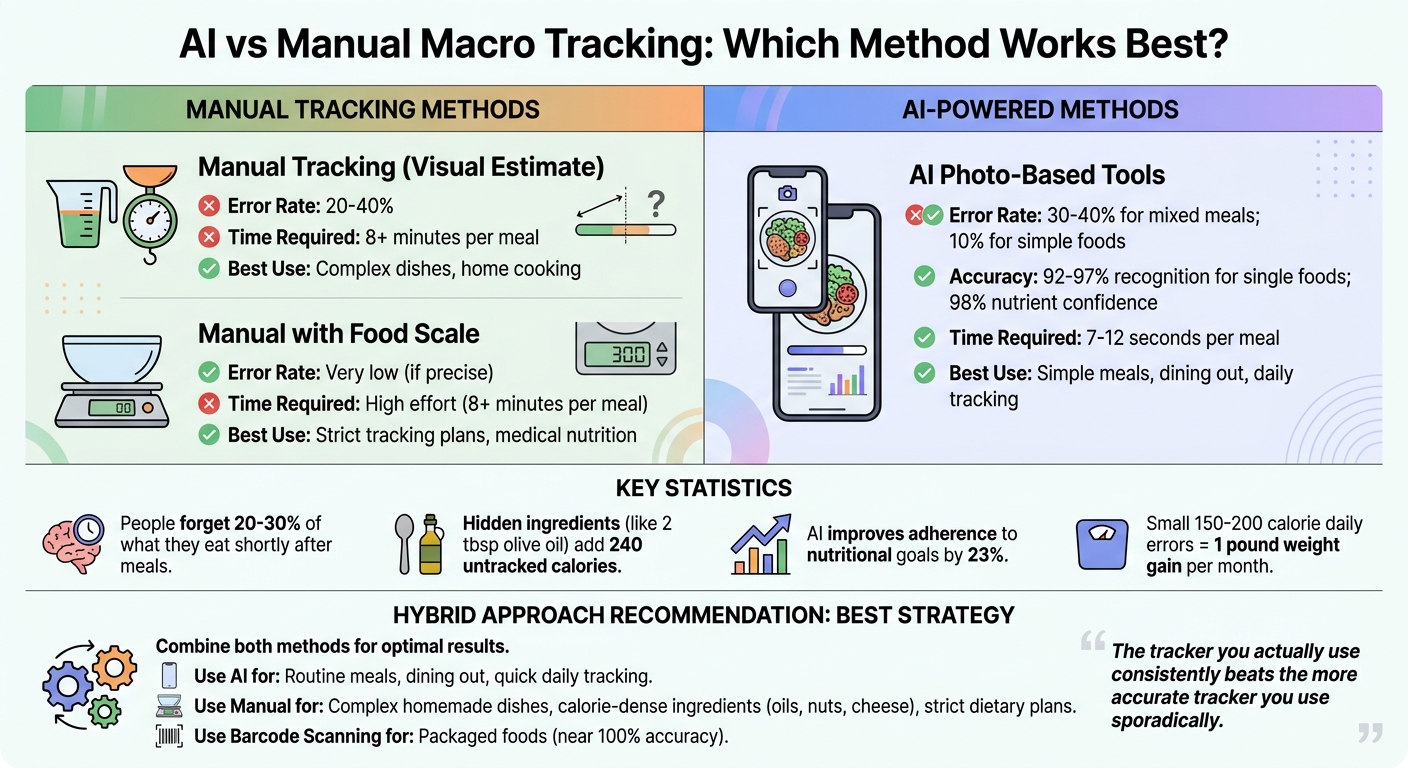
AI vs Manual Macro Tracking Comparison: Accuracy, Time, and Best Use Cases
I Tested AI Calorie Scanners… Most Were WRONG
sbb-itb-034be4e
Accuracy for Multi-Ingredient Meals
Keeping track of macros accurately is essential for hitting fitness and health goals, but when it comes to meals with multiple ingredients, each tracking method faces its own set of hurdles.
Limitations of Manual Macro Tracking
Manually tracking meals relies heavily on memory and estimation - and both can be unreliable. Research shows that people forget about 20–30% of what they eat shortly after a meal. This problem becomes even trickier with complex dishes. Imagine trying to recall every ingredient in a stir-fry or casserole - it's easy to miss something.
Then there's the issue of hidden ingredients. For example, you might log the chicken and vegetables in a roasted dish but forget about the two tablespoons of olive oil used, which add 240 calories. These small oversights can lead to big inaccuracies.
The quality of food databases also complicates things. Search for "chicken breast" in a tracking app, and you'll find dozens of entries with calorie counts that can vary by 100% or more. Without a food scale, you're left guessing if your portion matches the database entry, and visual estimates often come with error rates of 20–40%. These challenges make it clear why better tools are needed.
How AI Improves Nutritional Analysis
AI-powered tools like What The Food tackle these issues by automating ingredient identification and using advanced volume estimation. With just a photo, AI can recognize thousands of food items and even break down complex recipes. This process takes only 7–12 seconds, compared to the several minutes manual tracking often requires.
Modern AI takes it a step further with depth sensors like LIDAR, which measure food volume in 3D. By analyzing clues like plate dimensions, these tools estimate portion sizes far more accurately than the human eye. For example, What The Food achieves a 98% nutrient confidence level when compared to validated food databases. For single-item foods, top AI apps boast recognition accuracy rates of 92–97%.
AI also sidesteps social desirability bias - the tendency to underreport food intake during manual logging. Users can even enhance the AI's analysis by adding voice notes, such as "cooked in one tablespoon of butter", to account for hidden fats and oils.
Accuracy Comparison: AI vs Manual Tracking
Both AI and manual tracking have their strengths and weaknesses with complex dishes, but AI stands out for its speed and consistency. For simple foods like fruits or plain chicken breast, AI reduces error rates to about 10%, while manual tracking using visual estimates has error rates between 20–40%.
| Tracking Method | Error Rate (Complex Dishes) | Time Required | Main Limitation |
|---|---|---|---|
| Manual Tracking | 32% average underestimate | High (8+ minutes per meal) | Memory lapses, database errors |
| AI-Powered (What The Food) | 30–40% | 7–12 seconds | Hidden fats/oils not visible in photos |
| Manual with Food Scale | 20–40% | High (8+ minutes per meal) | Time-intensive, requires preparation |
AI tools not only save time but also deliver accuracy levels comparable to traditional methods, making them a practical choice for everyday use.
As one nutrition expert put it:
"A calorie tracker that produces numbers off by 15% but gets used every day is more useful than one that's theoretically more precise but too tedious to stick with." - Jamie, Author at Macaron
For multi-ingredient meals, AI offers similar accuracy to manual methods but with a fraction of the effort, making it easier for people to stay consistent with their tracking.
Time Efficiency and User Experience
The way you track macros can significantly influence how well you stick to your nutritional goals. The choice between AI-based tracking and manual methods isn't just about accuracy - it's about how seamlessly the method fits into your daily life.
How Fast AI Tools Work
AI-powered tools like What The Food make tracking almost effortless. Take a quick photo of your meal, and the app identifies foods, estimates portion sizes, and calculates macros in just 7–12 seconds. For $9.99/month, the premium version removes scan limits, making it a great option for anyone who tracks every meal. Even the free version delivers reliable AI-powered food detection and macro tracking, although with a daily scan cap. This level of speed and convenience highlights why AI tools are so appealing compared to manual tracking.
Why Manual Tracking Takes Longer
Manual tracking, on the other hand, is a time-consuming process. You have to search through food databases, select the closest match for each ingredient, and either estimate or weigh portions individually. Logging a simple meal can take 3 to 5 minutes. For more complex dishes like casseroles or stir-fries, the process can stretch to 8 minutes or more, as every ingredient needs to be recorded separately. Over time, the extra effort required for manual entry can disrupt consistency, leading many to give up on tracking within weeks. These delays can have a ripple effect, making it harder to stay on track with long-term goals.
How Ease of Use Affects Long-Term Tracking
Consistency is the backbone of hitting long-term health targets. Research shows that AI-assisted tracking improves adherence to nutritional goals by 23% compared to manual methods.
"The tracker you actually use consistently beats the more accurate tracker you use sporadically."
When tracking is as simple as snapping a photo, it becomes far easier to stick with - especially in situations like dining out or social events where pulling out a food scale just isn’t realistic.
Portion Size Estimation
Getting portion sizes right is just as important as tracking macros accurately. Even small daily errors - like underestimating by 150–200 calories - can add up, potentially leading to about one pound of unexpected weight gain per month. For someone on a 1,600-calorie plan, that’s roughly a 10% margin of error.
Manual Measurement Tools
When it comes to precision, kitchen scales are the go-to option for tracking multi-ingredient meals. By weighing each ingredient before cooking, you eliminate guesswork. However, this method can be time-consuming and takes up a good chunk of counter space. Measuring cups and spoons are a more convenient option, especially for liquids and grains, but they’re not foolproof. For instance, eyeballing a tablespoon of peanut butter can easily lead to a 90–100 calorie miscalculation. While visual estimation is quick, it often sacrifices accuracy.
For a faster, tech-driven alternative, AI-based tools are stepping in to simplify portion estimation.
How AI Estimates Portions from Images
AI tools, like What The Food, use depth sensors such as LiDAR to capture the 3D volume of food, offering quick portion estimates. Under ideal conditions, these tools achieve impressive recognition accuracy, ranging from 92% to 97% for single food items. However, they do have limitations. AI can only evaluate what’s visible on the plate, meaning hidden ingredients - like oils, butter, or sugar blended into sauces - can go unnoticed. For complex dishes, error rates can climb to 30–40%. Still, AI shows promise. In one validation study, AI achieved a Mean Absolute Error (MAE) of 0.25 for liquids like peach juice, significantly better than the 0.90 MAE recorded with manual visual estimation.
Here’s a quick breakdown of how manual and AI-based methods stack up:
Portion Estimation Comparison: AI vs Manual Methods
| Method | Accuracy Level | Effort Required | Best For |
|---|---|---|---|
| Manual (Scale) | Very High | High effort; requires equipment | Home cooking and strict tracking |
| Manual (Cups/Spoons) | High | Moderate effort; requires tools | Liquids and grains |
| AI (Standard Photo) | Medium | Very fast; snap and go | Simple foods and dining out |
| AI (LiDAR/Depth) | Medium-High | Fast; requires specific hardware | Solid food volume estimation |
| Manual (Eyeballing) | Low | Easiest; high error rate | General awareness only |
In real-world use, AI tools shine when dealing with clearly plated, straightforward foods. But they often struggle with mixed dishes where calorie-dense ingredients, like oils or butter, are hidden in sauces or casseroles. For maximum accuracy, especially with high-calorie items like oils and nuts, a kitchen scale remains the most reliable choice. AI, on the other hand, provides a handy alternative for simpler meals or when you’re dining out.
Combining AI and Manual Methods
To get the best of both worlds - speed and accuracy - a combination of AI and manual tracking works wonders. Let AI take care of the day-to-day meal tracking while you step in to verify details when precision is critical. This blend makes macro tracking more manageable and sustainable over time. Here’s how you can strike that balance.
Using AI as Your Main Tool
For your primary tracking needs, What The Food is a solid choice. It provides a full macro breakdown in just 7 to 12 seconds, boasting a 98% nutrient confidence rate when cross-checked with verified food databases. This speed and accuracy make it perfect for busy schedules, especially with simple foods like grilled chicken, fresh fruit, or restaurant meals where weighing ingredients isn’t practical.
For packaged foods or multi-ingredient dishes, barcode scanning is a game-changer. It pulls data directly from verified sources, offering close to 100% accuracy. This makes it especially handy for store-bought ingredients used in homemade recipes, removing much of the guesswork.
When to Verify Results Manually
AI is fast, but it’s not foolproof - especially with complex dishes like casseroles, stews, or stir-fries. For these kinds of meals, error rates can climb to 30–40%. Start with AI-generated estimates, but double-check calorie-dense ingredients like oils, butter, nuts, or cheese manually to ensure accuracy.
Manual verification is also crucial in situations where precision is non-negotiable. This includes strict calorie deficits, medical nutrition plans, or specific athletic performance goals. Nutrition expert Gemma Ray, RDN, explains:
"The accuracy and clarity help our athletes understand what fuels their performance. It's like having a dietitian assistant available 24/7".
When your health or performance depends on precise tracking, compare AI outputs with the actual portions you’ve prepared to ensure nothing slips through the cracks.
Creating a Personal Recipe Database
One way to streamline your tracking routine is by building a custom recipe database. Start by using What The Food’s AI recipe generator to log your dishes. Review and correct any ingredient details manually, then save the recipe for easy future use.
With the Recipe Saver feature (available on the free plan) or premium Recipe Tools, you can store meals for quick, one-click entries. For example, once you’ve saved your go-to chicken pasta or breakfast bowl, you won’t need to re-enter the details again. Premium members also benefit from unlimited scan history, allowing you to create a growing library of your favorite meals. This approach reduces repetitive work while maintaining the accuracy you’ve established through manual checks.
Conclusion
Tracking macros for multi-ingredient meals can be approached in two main ways: manually or with AI-powered tools. Each method has its strengths. Manual tracking allows for greater precision when you meticulously weigh and log each ingredient. However, it can be time-consuming and prone to errors from memory slips, database inconsistencies, or inaccurate visual estimates.
AI tools, like What The Food, simplify the process significantly. By snapping a photo of your meal, you can get a detailed macro breakdown - including calories, protein, carbs, and fat - in just 10 to 30 seconds. This convenience leads to better adherence to nutritional goals, with studies showing a 23% improvement compared to manual tracking methods. As Jamie from Macaron puts it:
"The tracker you actually use consistently beats the more accurate tracker you use sporadically."
The best strategy? A mix of both methods. Let AI handle the bulk of your tracking, especially for routine meals, while manual verification comes into play for more complex dishes or when precision matters most. Use barcode scanning for packaged foods to refine accuracy, and rely on manual checks for homemade meals or strict dietary plans. This hybrid approach balances convenience with reliability, helping you stick to your goals without feeling overwhelmed.
Consistency is what truly matters. With What The Food's free plan, you get access to auto food logging, a meal history tracker, and a recipe saver - tools designed to help you build lasting habits. For those seeking advanced features like macro analytics and meal planning, the premium plan at $9.99/month offers even more functionality. Whether you're tracking for fitness or performance, finding a system you can stick with is essential - and AI makes that easier than ever.
FAQs
How can I make AI macro estimates more accurate for mixed meals?
To get better macro estimates from AI for mixed meals, focus on refining portion size accuracy and improving ingredient recognition. Challenges often arise with complex dishes or hidden ingredients, which can throw off calculations. A helpful approach is to break recipes into individual components, upload several images of the dish, and cross-reference the AI's estimates with trusted nutritional databases. Using advanced tools like 3D analysis can also boost accuracy. When necessary, manually adjust portion sizes to help the AI deliver more precise macro tracking.
When should I weigh ingredients instead of using a meal photo?
When precision matters - like for intricate recipes, meals with numerous ingredients, or when tracking calories and macronutrients closely - it's best to weigh your ingredients. While AI tools such as What The Food can handle straightforward foods fairly well, they may falter with mixed dishes, sometimes showing errors as high as 30–40%. Using a kitchen scale provides more dependable results, which is especially important for strict diets or medical requirements where accuracy is non-negotiable.
What’s the easiest way to track oils, sauces, and other hidden calories?
AI-powered tools such as What The Food simplify the process of tracking hidden calories from ingredients like oils, sauces, and more. By analyzing photos of your meals, these tools deliver detailed nutritional information, even accounting for often-overlooked elements like olive oil - which can add anywhere from 150 to 200 calories per meal. This photo-based method ensures precise macro tracking by automatically estimating portion sizes and calorie content, helping to minimize the risk of missing those sneaky, hidden calories.