
How Many Calories Are in Common Fruits? A Complete Guide
How Many Calories Are in Common Fruits? A Complete Guide
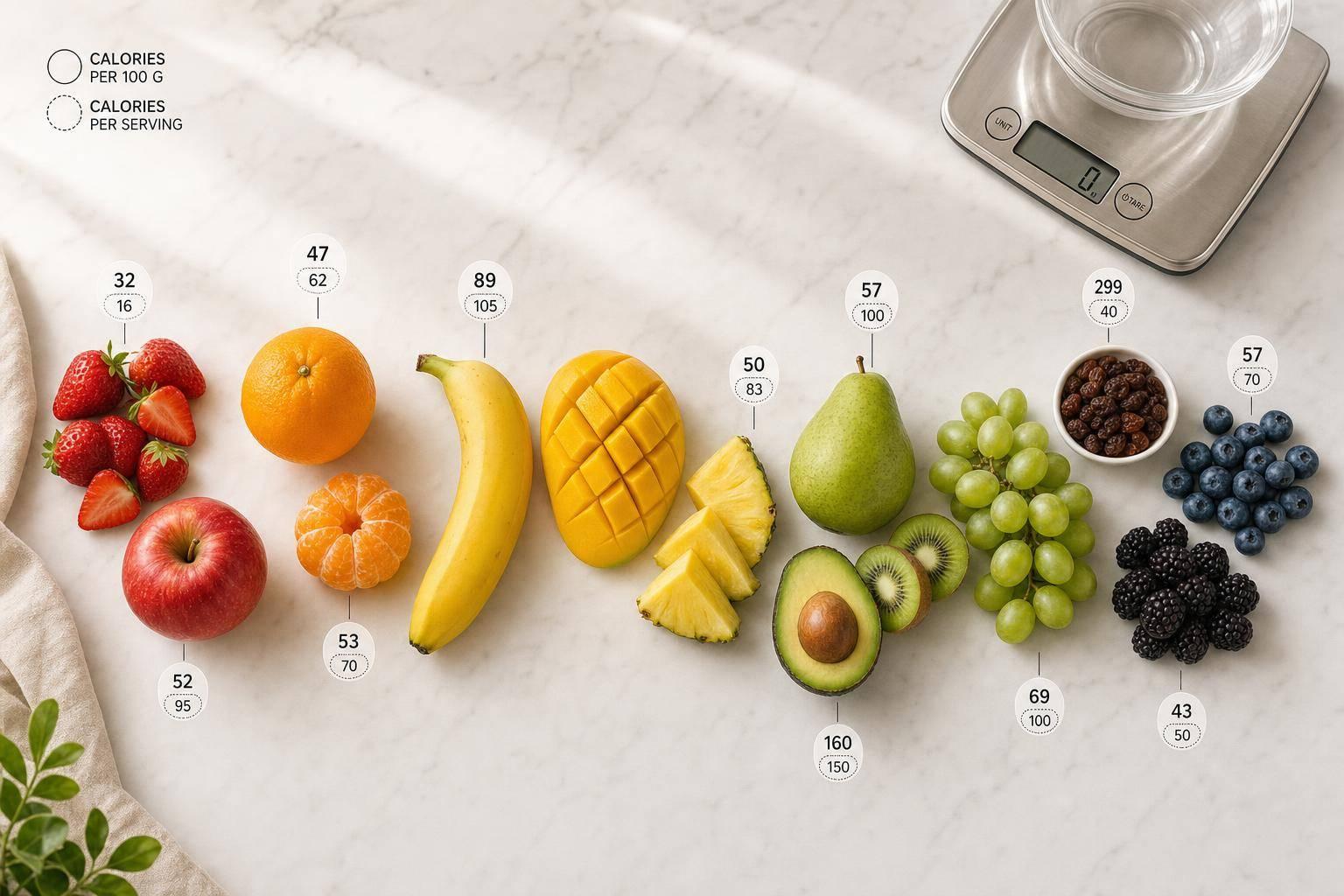
Fruit calories can swing a lot by portion size. A medium banana has 105 calories, a medium apple has 95, a medium orange has 62, and 1 cup of strawberries has just 49. If I want to track fruit with fewer mistakes, I need to look at both the serving size and the per 100 g number.
Here’s the short version:
- Lowest-calorie picks by 100 g: cucumber (15 cal), tomato (18 cal), watermelon (30 cal), strawberries (32 cal)
- Middle range: orange (47 cal), apple (52 cal), blueberries (57 cal), mango (60 cal), grapes (67 cal)
- Highest here by 100 g: banana (89 cal)
- Portion changes everything: 1 cup of watermelon is 46 cal, but 1 slice is 86 cal
- Dried fruit and juice add up fast: raisins are about 120 calories per 1/4 cup, and 8 oz of orange juice has about 110 calories
- Avocado is much higher: about 160 calories per 100 g or 320 calories for a medium avocado
If I’m logging fruit, the main rule is simple: match the entry to what I ate. That means using entries like 1 medium banana, 1 cup sliced mango, or 100 g instead of guessing.
Quick Comparison
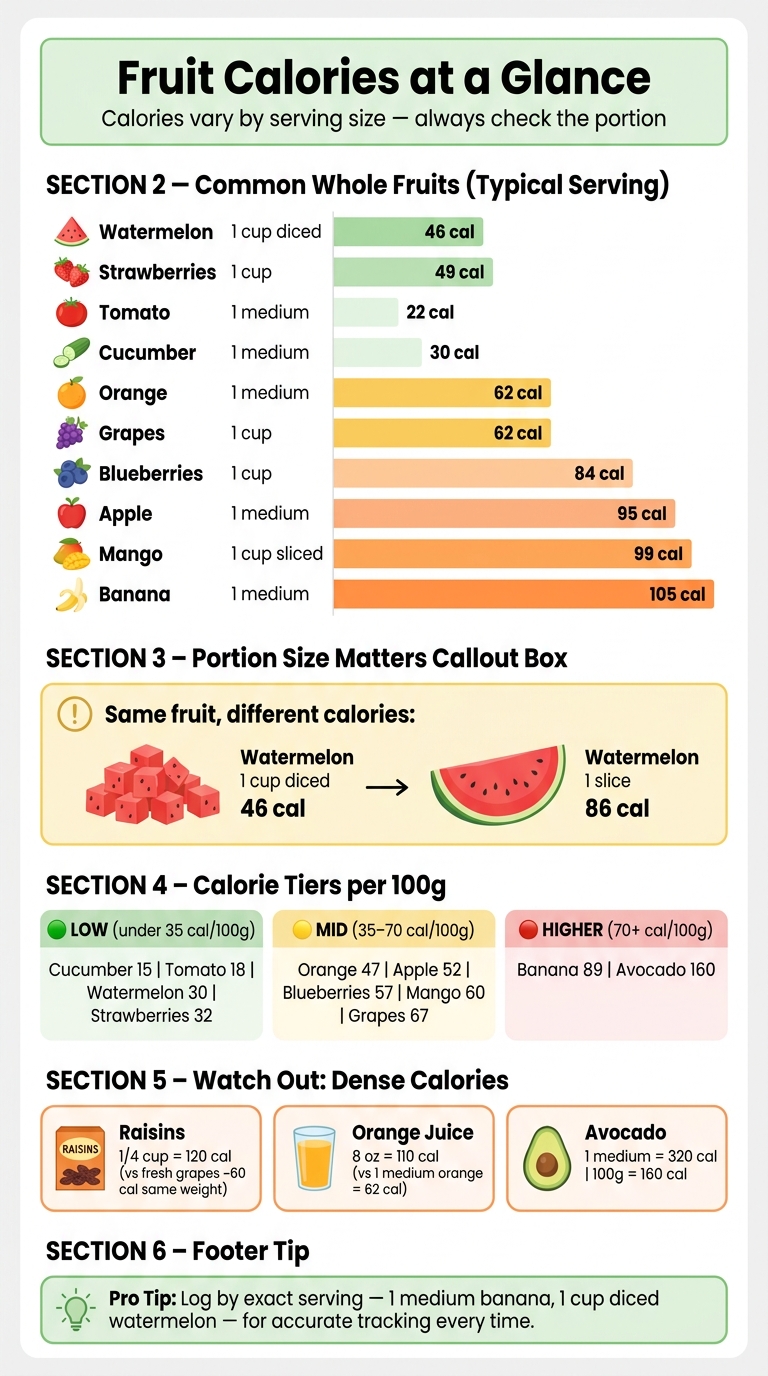
Fruit Calories by Serving Size: A Visual Comparison Guide
| Item | Serving | Calories | Key point |
|---|---|---|---|
| Apple | 1 medium | 95 | Middle range snack |
| Banana | 1 medium | 105 | Highest of the common whole fruits listed |
| Orange | 1 medium | 62 | Lower than apple and banana |
| Strawberries | 1 cup | 49 | Low calories for a big bowl |
| Blueberries | 1 cup | 84 | Small fruit, calories stack fast |
| Grapes | 1 cup | 62 | Easy to eat more than planned |
| Mango | 1 cup sliced | 99 | Close to a banana by serving |
| Watermelon | 1 cup diced | 46 | Low by cup |
| Watermelon | 1 slice | 86 | Same fruit, bigger portion |
| Tomato | 1 medium | 22 | Very low calorie |
| Cucumber | 1 medium | 30 | Very low calorie |
| Raisins | 1/4 cup | 120 | Dried fruit is dense |
| Orange juice | 8 oz | 110 | Less fiber, easy to drink fast |
| Avocado | 1 medium | 320 | Much higher due to fat |
So the takeaway is simple: fruit is not “high” or “low” calorie on its own. The serving decides the number.
sbb-itb-034be4e
Calories in Common Fruits by Typical Serving
Below are calorie counts for common fruits based on the portions people usually eat. That makes the numbers easier to use in day-to-day meals and snacks.
Apples, Bananas, and Oranges
| Fruit | Serving | Calories | Carbs |
|---|---|---|---|
| Apple | 1 medium (182 g) | 95 cal | 25 g |
| Apple | 100 g | 52 cal | 14 g |
| Banana | 1 medium (118 g) | 105 cal | 27 g |
| Banana | 100 g | 89 cal | 23 g |
| Orange | 1 medium (131 g) | 62 cal | 15 g |
| Orange | 100 g | 47 cal | 12 g |
A medium banana comes in highest here at 105 cal, while a medium orange is lower at 62 cal. Apples sit in the middle at 95 cal per medium fruit. The 100 g entries help if you like to weigh food instead of going by piece size.
Grapes, Berries, Mangoes, and Watermelon
| Fruit | Serving | Calories | Carbs |
|---|---|---|---|
| Grapes | 1 cup (92 g) | 62 cal | 16 g |
| Strawberries | 1 cup (152 g) | 49 cal | 12 g |
| Blueberries | 1 cup (148 g) | 84 cal | 21 g |
| Mango | 1 cup sliced (165 g) | 99 cal | 25 g |
| Watermelon | 1 cup diced (152 g) | 46 cal | 11 g |
| Watermelon | 1 slice (286 g) | 86 cal | 22 g |
| Tomato | 1 medium (123 g) | 22 cal | 5 g |
| Cucumber | 1 medium (201 g) | 30 cal | 7 g |
This group shows how much serving size can change the calorie total. For example, 1 cup of watermelon has 46 cal, but 1 slice has 86 cal because the portion is much bigger. Tomatoes and cucumbers are on the low end, with 22 cal and 30 cal per medium item.
Fruit Calorie and Macro Comparison Table
| Fruit | 100 g | Calories | Carbs | Fiber | Sugar |
|---|---|---|---|---|---|
| Apple | 100 g | 52 cal | 14 g | 2.4 g | 10 g |
| Banana | 100 g | 89 cal | 23 g | 2.6 g | 12 g |
| Orange | 100 g | 47 cal | 12 g | 2.4 g | 9 g |
| Grapes | 100 g | 67 cal | 17 g | 0.9 g | 16 g |
| Strawberries | 100 g | 32 cal | 8 g | 2.0 g | 5 g |
| Blueberries | 100 g | 57 cal | 14 g | 2.4 g | 10 g |
| Mango | 100 g | 60 cal | 15 g | 1.6 g | 14 g |
| Watermelon | 100 g | 30 cal | 8 g | 0.4 g | 6 g |
| Tomato | 100 g | 18 cal | 4 g | 1.2 g | 2.6 g |
| Cucumber | 100 g | 15 cal | 3.6 g | 0.5 g | 1.7 g |
Looking at 100 g portions puts everything on the same playing field. Bananas are highest here at 89 cal and 23 g carbs per 100 g. Cucumbers are lowest at 15 cal and 3.6 g carbs, with tomatoes close behind at 18 cal and 4 g carbs. Strawberries and watermelon are also low in calories for their weight, at 32 cal and 30 cal per 100 g.
Next, these same fruits are grouped by calorie level to make portion choices easier.
Low-, Mid-, and High-Calorie Fruits at a Glance
Using the per 100 g values above, you can sort fruit calories into three simple buckets. That makes it much easier to compare options without overthinking every serving.
Lower-Calorie Fruits That Give You More Volume
- Cucumber – 15 cal
- Tomato – 18 cal
- Watermelon – 30 cal
- Strawberries – 32 cal
These fruits give you the most food volume for the fewest calories. So if you want a bigger portion without the calories piling up fast, this group is a smart place to start.
Moderate and Higher-Calorie Fruits to Watch in Portions
Mid-calorie (per 100 g):
- Orange – 47 cal
- Apple – 52 cal
- Blueberries – 57 cal
- Grapes – 67 cal
Higher-calorie (per 100 g):
- Mango – 60 cal
- Banana – 89 cal
This doesn’t mean these fruits are “bad.” It just means portions matter more. A banana or a handful of grapes can add up faster than watermelon or strawberries, even if the serving looks similar at first glance.
Macro Patterns Worth Knowing for Tracking
Lower-calorie fruits usually have more water and less sugar. That keeps both calories and carbs on the lower side. Mid-range fruits tend to bring more natural sugar and fiber. Bananas and mangoes land at the top because they pack more carbs and sugar into each gram.
If you track your food, these groups make logging and portion control a whole lot easier.
How to Use Fruit Calorie Data in Daily Eating and Tracking
Building Better Snacks and Meals with Fruit
Now that you know which fruits are lighter or denser, you can make portion choices much faster. If you want more food for fewer calories, go with lower-calorie fruits. If you want a snack that sticks with you a bit longer, pair fruit with protein or fat so it feels more satisfying.
How to Match Your Portions to App Entries
Consistency matters more than people think. Instead of logging "a banana", log "1 medium banana" and count it as about 105 calories for fast mental math. Stick with the same app entries each time, like 1 medium apple, 1 medium banana, 1 cup diced watermelon, or 1 cup sliced mango.
When you use the same entries day after day, your tracking gets more steady. And your weekly trends are much easier to read.
Using What The Food for Faster Portion and Macro Estimates

If manual logging feels slow, What The Food can make it easier. It can turn a meal photo into a portion estimate and calorie count, which helps when fruit is mixed into a bowl or snack. That can save time when you're logging fruit bowls and mixed snacks.
Next, dried fruit, juice, and avocado change the calorie picture even more.
Dried Fruit, Juice, Avocado, and Key Takeaways
One serving can change the picture fast when water is removed, juice is squeezed out, or the fruit has more fat.
Why Dried Fruit and Juice Pack More Calories
When fruit is dried, the water leaves and the calories get packed into a much smaller amount. A quarter cup of raisins has about 120 calories, while the same weight in fresh grapes has closer to 60 calories. Same fruit, very different portion feel.
Juice works in a similar way, but for another reason. Pressing fruit into juice strips out fiber, so you lose the bulk that helps slow you down and makes a serving feel filling. An 8-ounce glass of orange juice can have around 110 calories, compared to 62 calories for one medium orange. So even though the fruit name stays the same, the calorie total can almost double once water or fiber is gone.
That same calorie-density shift shows up in avocado too, but not because of drying or juicing.
Avocado: A Calorie-Dense Fruit With More Fat
Avocado has more calories than most fruits because a lot of its density comes from fat. One medium avocado, about 200 g, has roughly 320 calories and 29 g of fat. At 100 g, avocado comes in at around 160 calories. For comparison, apple has about 52 calories per 100 g, and watermelon has about 30 calories for the same weight.
Most of the fat in avocado is monounsaturated. But if you're tracking calories, the main point is simple: even a small serving can add up fast. In practice, half an avocado is usually the easier serving to log.
Use that same serving-size check with every fruit before you enter it.
Conclusion: Compare Fruit Calories by Serving Size
Fruit calories change the moment the serving size changes, whether the fruit is fresh, dried, juiced, or higher in fat. Check the serving first, then log the number that matches what you actually ate.
FAQs
Should I log fruit by piece, cup, or grams?
For the most accurate tracking, log fruit in grams with a digital food scale. A scale gives you a closer count than measuring cups, and pieces or cups are only rough guesses.
Fruit size, density, and ripeness can all change calorie counts. When you can, weigh fruit raw for more consistent nutrition logs, especially with calorie-dense fruits like avocado, grapes, or cherries.
Why do dried fruit and juice have more calories than fresh fruit?
Dried fruit and juice pack more calories into a smaller serving than fresh fruit. The main reason is simple: processing changes the volume, not just the form.
When fruit is dried, most of its water is removed. That shrinks the fruit and concentrates the natural sugars and calories into a much smaller portion. So you can eat a lot more dried fruit than fresh fruit before you feel full.
Juice works in a similar way. A single glass can contain the sugars and calories from several pieces of fruit, but without the fiber that helps whole fruit feel more satisfying. That missing fiber matters. It slows you down and helps you stay full longer, which is one reason whole fruit often feels like a snack, while juice can go down in a few sips.
Which fruits are best if I want more volume for fewer calories?
Choose water-rich fruits like watermelon, strawberries, cantaloupe, and other melons. They let you eat bigger portions that still feel satisfying without piling on calories.
Berries like raspberries and blackberries are also a smart pick because their fiber can help you stay full longer. Oranges, peaches, and plums add volume without many calories. Bananas, grapes, and avocado are more calorie-dense, so it helps to watch portion sizes a bit more closely.
Related Posts
Beginner's Guide to AI-Powered Macro Tracking
Estimate calories, protein, carbs, and fat from meal photos; fix portions and hidden fats, and track weekly trends with AI-assisted logging.
Manual vs AI Food Tracking: Which Method Works Better?
Manual tracking gives near-exact calories; AI photo logging is faster and boosts consistency—often a hybrid approach works best.
How Many Calories Are in a Slice of Pizza?
Typical cheese slice ≈285 kcal; slices range 170–700+. Size, crust, cheese, toppings and sodium drive the calorie difference.
MyFitnessPal Vs. WhatTheFood: Which Macro Tracker is Best?
AI meal-photo scanning often beats crowdsourced databases for faster, more accurate macro tracking—compare speed, accuracy, and value.