
Manual vs AI Food Tracking: Which Method Works Better?
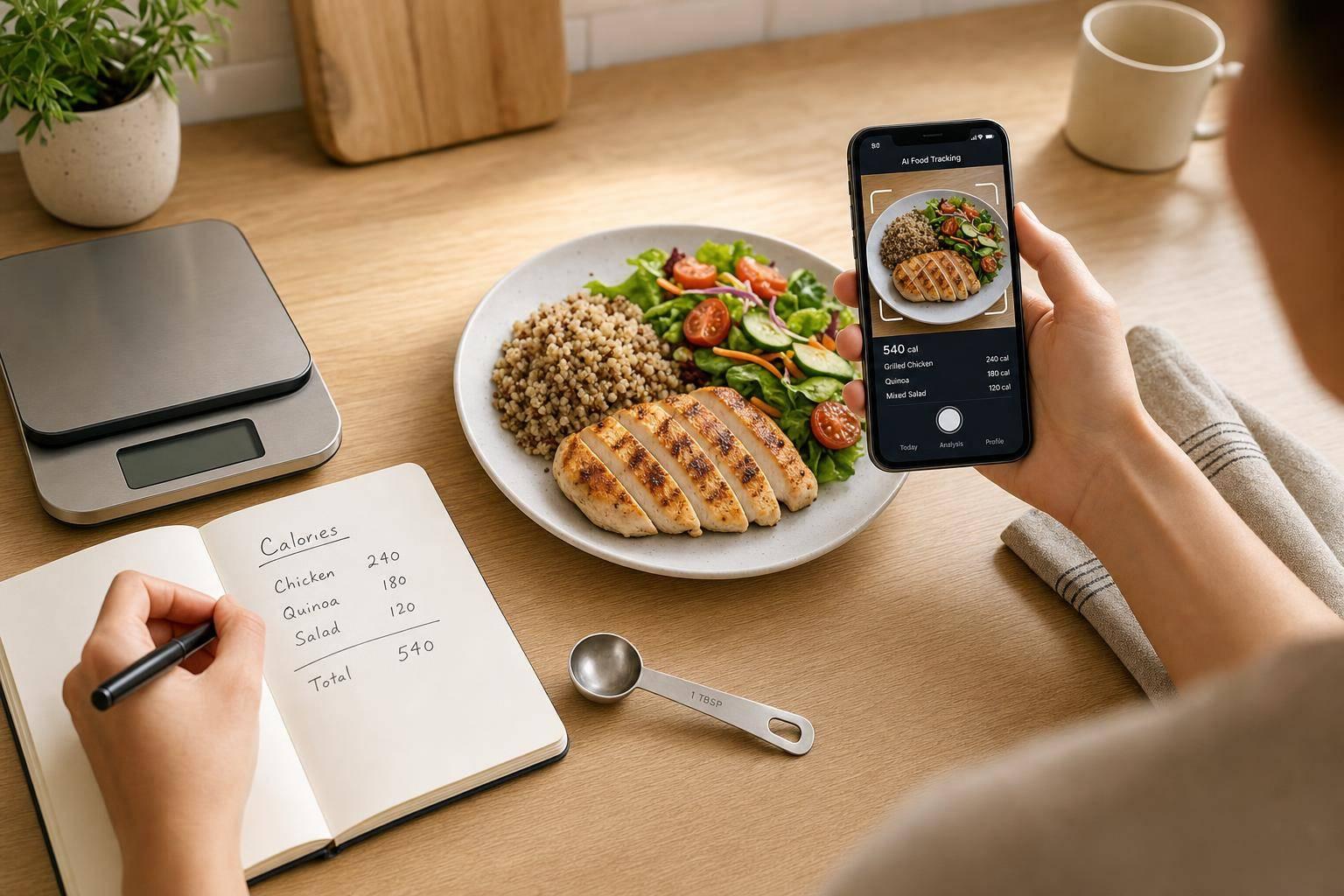
Manual vs AI Food Tracking: Which Method Works Better?
If I want the short answer: manual tracking is better for exact numbers, and AI tracking is better for sticking with the habit. That’s the trade-off.
Here’s what matters most to me from this comparison:
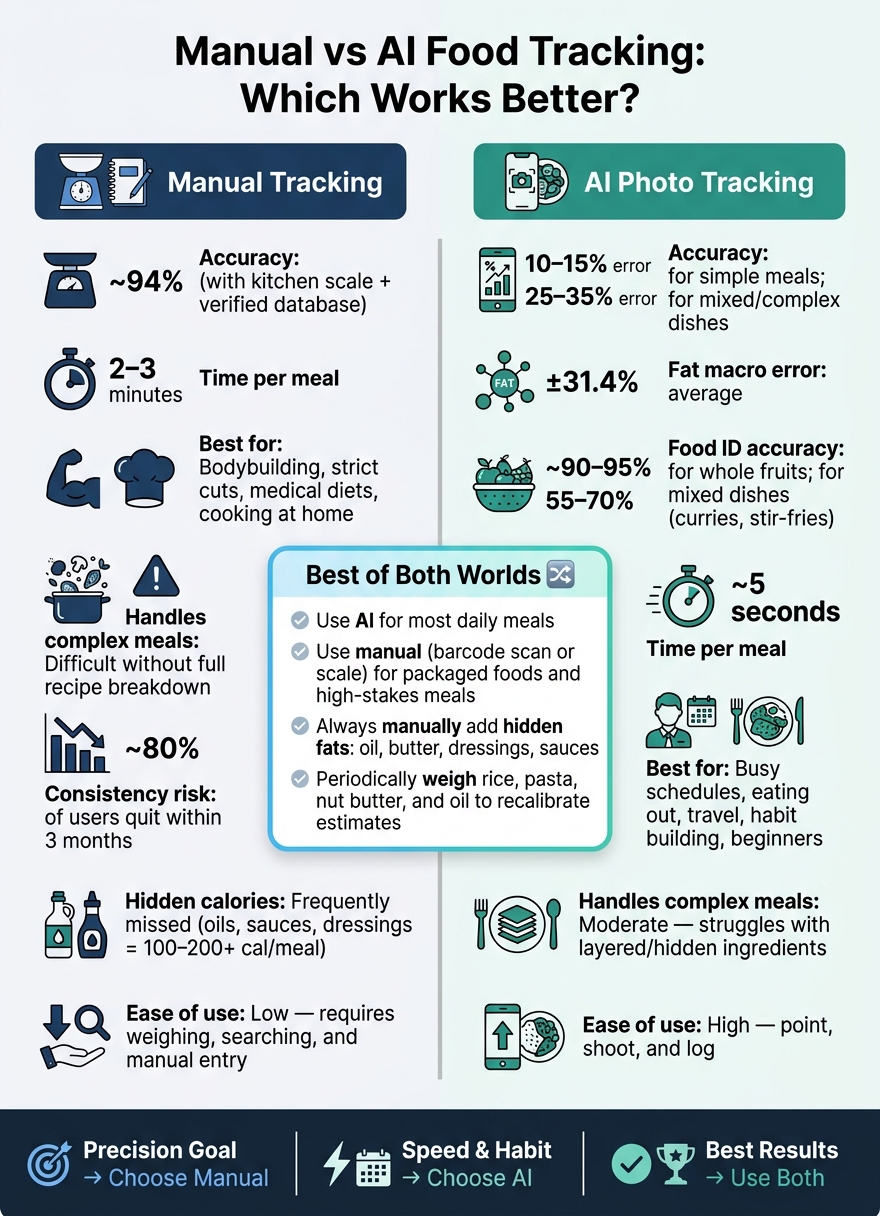
- Manual tracking can reach about 94% accuracy when I weigh food and use label or database data.
- AI photo tracking takes about 5 seconds per meal, while manual logging often takes 2 to 3 minutes per meal.
- AI is usually within 10% to 15% for simple meals, but errors can grow to 25% to 35% for mixed dishes.
- Hidden extras like oil, butter, sauces, and dressings can add 100 to 200+ calories per meal and often get missed either way.
- Manual works best for strict macro goals, bodybuilding, and medical diets.
- AI works best for busy days, eating out, travel, and habit building.
If I cook at home and want tight control, I’d go manual. If I need something I’ll keep using, I’d lean toward AI. And for a lot of people, the best setup is both: AI for most meals, manual for the meals where the numbers need to be closer.
Manual vs AI Food Tracking: Accuracy, Speed & Consistency Compared
I Tested AI Calorie Scanners… Most Were WRONG
sbb-itb-034be4e
Quick Comparison
| Method | Best for | Accuracy | Time | Main downside |
|---|---|---|---|---|
| Manual tracking | Exact calories and macros | About 94% with a scale | 2 to 3 min/meal | Takes more effort |
| AI photo tracking | Fast daily logging | 10% to 15% error for simple meals; 25% to 35% for mixed meals | About 5 sec/meal | Weaker with mixed foods and hidden fats |
| Using both | Most people | Better balance of speed and control | Varies | Needs a bit of review |
So when I compare the two, the answer isn’t just “Which one is more accurate?” It’s also: Which one will I still use next month?
How Manual Food Tracking Works
Manual tracking is pretty simple in theory: you measure a portion, match it to a nutrition label or database entry, scale the numbers, and log the result.
Food Journals, Spreadsheets, and Label-Based Logging
Manual tracking usually comes in two forms: scale-based logging and estimate-based journaling.
Scale-based logging is the tighter method. You weigh food in ounces or grams, scan a barcode or search a database, and enter the exact amounts. Estimate-based journaling is more relaxed. You write down what you ate, guess the portion sizes, and log a rough daily calorie total.
Whole foods make this harder because they need a database match. And raw-versus-cooked entries can shift the totals, sometimes more than people expect.
Where Manual Tracking Is Accurate and Where It Falls Short
When someone uses a kitchen scale and verified label data, manual tracking can reach about 94% accuracy. That makes it the most precise manual option for clinical nutrition protocols and weight-class sports.
But here's where things start to slip. Most people don't log with that level of care every single day. Small extras are easy to miss:
- Cooking oils
- Butter
- Sauces
- Salad dressings
Those add up fast. A stir-fry cooked in 2 tablespoons of oil can add about 240 calories and 28g of fat.
Then there's the time issue. Manual entry usually takes 2 to 3 minutes per meal. Over a month, that works out to around 90 separate data-entry sessions. That's a lot of small chores piled on top of daily life, and it's a big reason nearly 80% of people who start manual tracking quit within the first 3 months.
There's another catch: manual logs tend to undercount intake over time. Missed calories don't magically balance out later.
So yes, accuracy goes up when effort goes up. But consistency often drops when logging starts to feel like homework. That's the trade-off, and it's exactly where AI photo tracking starts to look different.
How AI Food Tracking Works with Meal Photos
Manual tracking means measuring, searching, and typing. AI cuts most of that down to a quick photo check. You take or upload a meal photo, and the AI picks out the foods, estimates portions, and calculates calories and macros. That makes it the faster option, but it's still based on estimates.
What The Food Features That Cut Logging Time
The system reads visible foods, estimates portions from visual cues, and links each item to nutrition data. In most cases, a full-plate scan takes about 5 seconds. Manual logging usually takes 2 to 3 minutes.
This is where AI saves time - and where a quick human check still matters.
| Task | AI Handles Automatically | You Should Review |
|---|---|---|
| Food Identification | Recognizes visible items by shape, color, and texture | Correct misidentified items or specify cuts when needed |
| Portion Estimation | Estimates volume using plate size and utensils | Adjust the estimate if it looks off |
| Calories & Macros | Calculates totals from nutritional databases | Add invisible inputs like cooking oil, butter, dressings, or sauces |
| Multi-Item Analysis | Breaks a full plate into individual food lines | Make sure layered or hidden items are visible |
| Complex Dishes | Estimates ingredients in mixed meals | Review and edit the ingredient list for accuracy |
What Affects AI Accuracy in Real Meals
AI tracking is fast, but it doesn't see meals the way a person does. The main issue is simple: a flat photo can't fully show depth, density, or weight. That's why accuracy tends to drop with layered or hidden foods.
For simple foods that are easy to see, a clear photo is often within 10% to 15% of actual calories. With mixed or more complicated meals - like restaurant dishes or plates with many ingredients - the error can climb to 25% to 35%. Fat is often the least precise macro, with an average error of ±31.4%.
Liquid and blended meals can be a headache too. Soups and smoothies are harder for the AI to read. A 45-degree angle usually gives the app better depth cues, and you should still add ingredients the camera can't spot, like oil, butter, dressings, or sauces. Those hidden extras can add 100 to 200+ calories per meal.
That time savings matters most when you want speed without letting your log drift too far off course.
Manual vs AI: Head-to-Head Comparison for Calories, Macros, and Consistency
This choice usually comes down to three things: accuracy, meal complexity, and whether you'll stick with logging day after day.
| Feature | Manual Tracking (with Scale) | AI Photo Tracking |
|---|---|---|
| Calorie Accuracy | High with scale | Good for simple meals; weaker for mixed dishes |
| Macro Accuracy | High when ingredients are separated | Weaker with hidden fats, sauces, and layered foods |
| Time Per Day | 2–3 minutes per meal | About 5 seconds per meal |
| Ease of Use | Low; requires searching and weighing | High; point and shoot |
| Complex Meal Handling | Difficult without a full recipe breakdown | Moderate; estimates are weaker when ingredients are layered or hidden |
| Best Use Case | Bodybuilding, strict cuts, clinical needs | General weight loss, habit building, busy schedules |
Calorie Counting and Weight Management
Manual tracking is the more precise option. If you use a kitchen scale and a nutrition database, you can get to about 94% accuracy. That's strong on paper.
The problem is that precision doesn't help much if people stop logging. About 80% of people in weight-loss programs quit manual tracking within three months because it feels like too much work.
AI takes the opposite path. It gives up some precision, but it's much easier to use every day. For simple foods, it's usually within a 10%–15% error margin. With mixed meals, that gap can drift to 25%–35%.
There's another wrinkle here. AI usually improves logging adherence compared with manual entry. And while manual tracking can look more exact, people still under-report intake by nearly half. AI mistakes are often more random, so they tend to even out over time.
Put simply: manual favors precision, while AI favors follow-through. If you're aiming for strict targets, manual has the edge. If you need a system you'll keep using, AI often fits better.
Macro Tracking, Complex Meals, and Fitness Goals
When macros matter, the main issue is pretty simple: do you need exact ingredient control, or do you just need a decent estimate?
Manual tracking works better when you cook at home and weigh each ingredient on its own. That kind of control matters for muscle gain, strict cuts, and other cases where small gaps add up. If you want to know how much protein, fat, or carbs you're eating, separating ingredients gives you a cleaner read.
AI does fine with straightforward meals, but mixed dishes are where things get messy. It can identify whole fruits at about 90%–95%, but mixed dishes like curries or stir-fries fall to 55%–70%. Hidden oils, sauces, and layered foods make the job much harder.
Restaurant meals are a different story. Manual tracking sounds great until you're sitting in a booth with a burrito bowl and no scale. In that case, AI has a clear edge. A photo won't be perfect, but it's a lot better than making a total guess.
So the split is pretty clear: manual is better for ingredient-level control; AI is better when meals are hard to weigh in normal life.
Day-to-Day Consistency and Ease of Use
For most people, consistency is the thing that decides everything.
Manual tracking tends to work best for people who like detail and don't mind the daily bookkeeping. If your meals are pretty predictable and you like having tight control, the extra effort can pay off.
But for a lot of people, that friction builds fast. Searching foods, weighing portions, and entering each item can start to feel like doing homework before every meal.
AI cuts most of that out. You take a quick photo, log the meal, and move on. That makes it much easier to fit into a busy day.
And that's the big trade-off: consistent logs usually beat perfect-but-incomplete logs.
How to Choose the Right Tracking Method for Your Life
If accuracy and convenience pull in different directions, let your daily routine settle it.
Matching the Method to Your Personality, Schedule, and Goal
The best method is the one you can stick with for months.
If you like detail and have time for it, manual tracking is usually the better fit. That kind of control makes sense for bodybuilders, people in a strict cut, or anyone dealing with a strict medical diet.
If your days are packed, AI tends to fit better because it asks less from you.
Here’s a quick way to match your situation to the right option:
| Your Situation | Best Fit |
|---|---|
| Cook at home, want exact macros | Manual (scale + database) |
| Busy schedule, eat out often | AI photo tracking |
| Just starting out, building habits | AI photo tracking |
| Competition prep or medical diet | Manual (scale + database) |
| Traveling or at social events | AI photo tracking |
When to Use Both Methods Together
You don’t have to pick one method for every meal.
A lot of people do better with a mix: AI for most meals, manual logging when precision matters most. That usually looks like this:
- Use AI for routine meals. Save manual logging for high-stakes meals, and let AI handle the rest.
- Use barcode scanning for packaged foods. It pulls exact label data for protein bars, snacks, and other packaged items.
- Add invisible calories manually. If a meal has hidden fats, like oil used in cooking, butter, or dressings, log those by hand. The camera can’t see them, but they add up fast.
It also helps to weigh rice, pasta, nut butter, and oil once in a while to fix portion estimates.
FAQs
How accurate is AI for restaurant meals?
AI is moderately accurate for restaurant meals. The main problem is simple: cameras can’t see everything. Hidden ingredients like oils, butter, and sauces often blend into the dish or sit underneath it, so the estimate can miss them.
In most cases, AI can identify the meal and give a decent estimate for the full plate. But once the dish gets mixed, layered, or more complex, the margin of error can land around 25% to 35%.
For better results, use AI with well-lit photos and plates that are clearly visible. It also helps to add manual details for cooking methods, hidden fats, or portions shared with other people.
Can I combine manual and AI tracking?
Yes. Mixing manual and AI tracking is often the best way to do it.
You get fast daily logging from AI, plus better accuracy from manual input when meals get messy or your goals get more specific.
For example, you might let AI log standard meals first. Then you can manually tweak portion sizes, add cooking oils, or scan packaged foods. That fills in common gaps, like unclear serving amounts or dishes that don’t fit neatly into a standard food database.
It’s a simple setup, but it works well when you want both speed and better numbers.
Which method is better for macro goals?
No single method wins every time. For macro goals, the best option depends on your lifestyle and what you're trying to do, but a hybrid approach usually works best.
Use AI photo scanning when you want speed and steady tracking. Then fill in the gaps with manual entry or weighing for foods that are tough to judge, like oils, sauces, and nut butters. For packaged foods, barcode scanning is usually the most accurate.
Related Posts
Beginner's Guide to AI-Powered Macro Tracking
Estimate calories, protein, carbs, and fat from meal photos; fix portions and hidden fats, and track weekly trends with AI-assisted logging.
How Many Calories Are in a Slice of Pizza?
Typical cheese slice ≈285 kcal; slices range 170–700+. Size, crust, cheese, toppings and sodium drive the calorie difference.
How Many Calories Are in Common Fruits? A Complete Guide
Calories in common fruits by serving and per 100 g, plus tracking tips, dried fruit and avocado calorie differences.
MyFitnessPal Vs. WhatTheFood: Which Macro Tracker is Best?
AI meal-photo scanning often beats crowdsourced databases for faster, more accurate macro tracking—compare speed, accuracy, and value.