
How Many Calories Are in a Slice of Pizza?
How Many Calories Are in a Slice of Pizza?
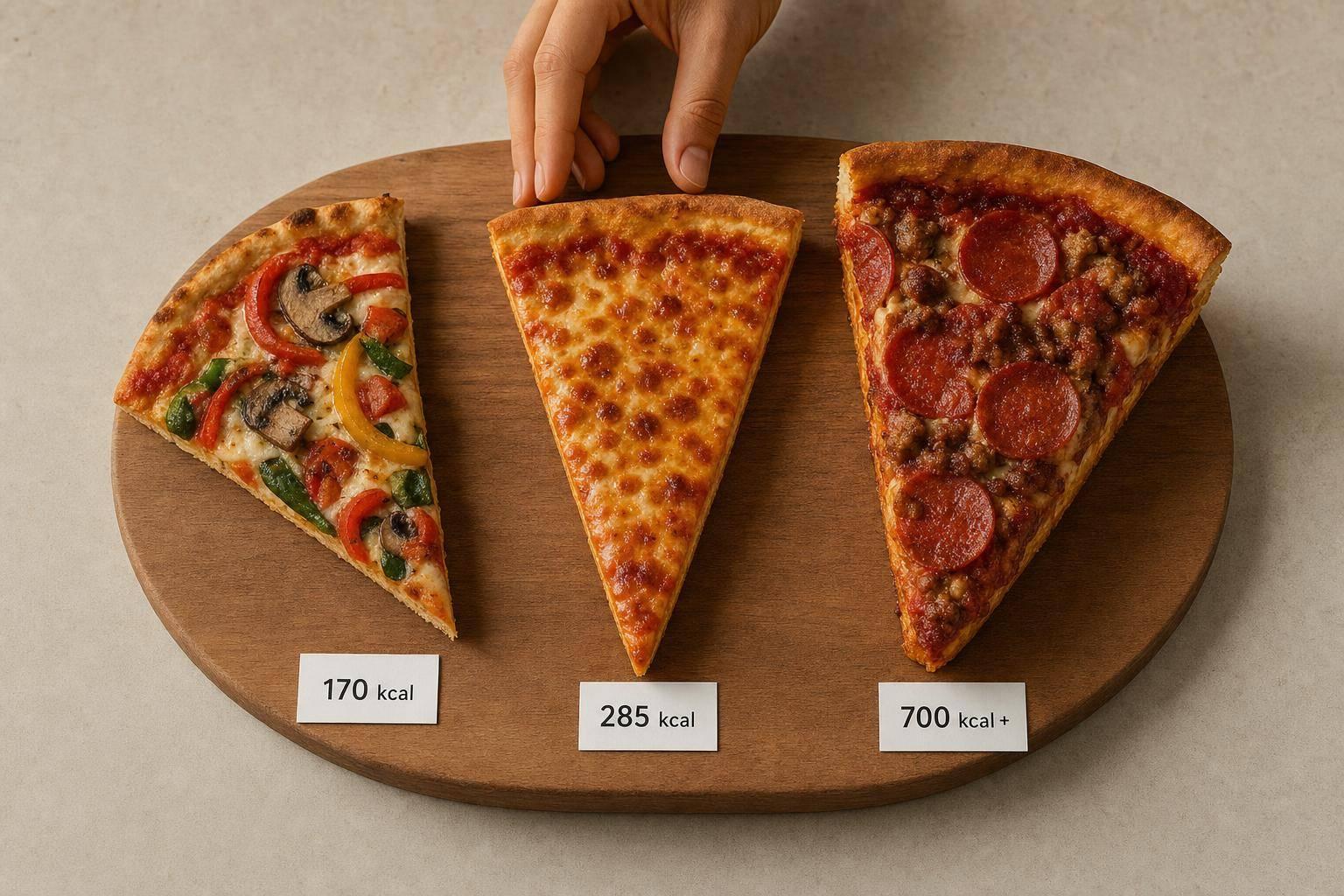
A plain cheese slice is usually about 285 calories - but one slice can range from 170 to 700+ calories depending on size, crust, and toppings.
If I want a fast answer, that’s it. But if I want a better estimate, I need to check 4 things first:
- Slice size: a standard U.S. slice is often 1/8 of a 14-inch pizza
- Crust type: thin crust is lower; deep dish and pan run higher
- Cheese amount: extra cheese can add 50 to 150 calories
- Toppings and sauce: veggies add little; meats and white sauce add more
Here’s the short version:
- Cheese slice: about 270–300 calories
- Pepperoni slice: about 300–330 calories
- Veggie slice: about 230–260 calories
- Thin crust slice: about 200–220 calories
- Deep-dish slice: about 350–535 calories
- Meat-heavy slice: about 380–550 calories
A standard cheese slice also has about 12.2g protein, 35.6g carbs, 10.4g fat, and 640mg sodium. So if I eat 2 slices, I’m often at about 570 calories and over 1,200mg sodium before adding soda, wings, or dip.
| Slice type | Usual calories |
|---|---|
| Cheese | 270–300 |
| Pepperoni | 300–330 |
| Veggie | 230–260 |
| Thin crust | 200–220 |
| Deep dish | 350–535 |
| Meat-heavy | 380–550 |
Bottom line: I can use 285 calories as a starting point, but the best estimate comes from looking at the slice size first, then the crust, cheese, sauce, and toppings.
Nutrition Facts for a Typical Slice of Pizza
Calories and Macros in a Plain Cheese Slice
A standard cheese slice comes in at 285 calories. For one 107 g slice, here’s the breakdown:
| Nutrient | Amount per Slice (107g) | % Daily Value |
|---|---|---|
| Calories | 285 kcal | 14% |
| Protein | 12.2g | 24% |
| Total Fat | 10.4g | 13% |
| Saturated Fat | 4.8g | 24% |
| Carbohydrates | 35.6g | 12% |
| Dietary Fiber | 2.5g | 9% |
| Sodium | 640 mg | 28% |
Based on USDA FoodData Central for a 14-inch regular crust cheese pizza.
What These Numbers Mean for Meal Tracking
If you’re tracking meals, three numbers matter most here: calories, sodium, and carbs.
The first thing that jumps out is sodium. At 640 mg per slice, you’re already at 28% of the Daily Value from just one piece. That adds up fast, especially if two slices feels like a light meal.
Carbs make up the biggest share of the slice, with fat and protein behind them. That makes sense when you think about how pizza is built. The dough brings most of the carbs, while the cheese does most of the work for fat and protein.
And that’s just the plain cheese version. Switch the crust, pile on toppings, or go with a different pizza style, and those numbers can change fast.
sbb-itb-034be4e
How Many Calories in Pizza Slice?
Calories per Slice by Pizza Type
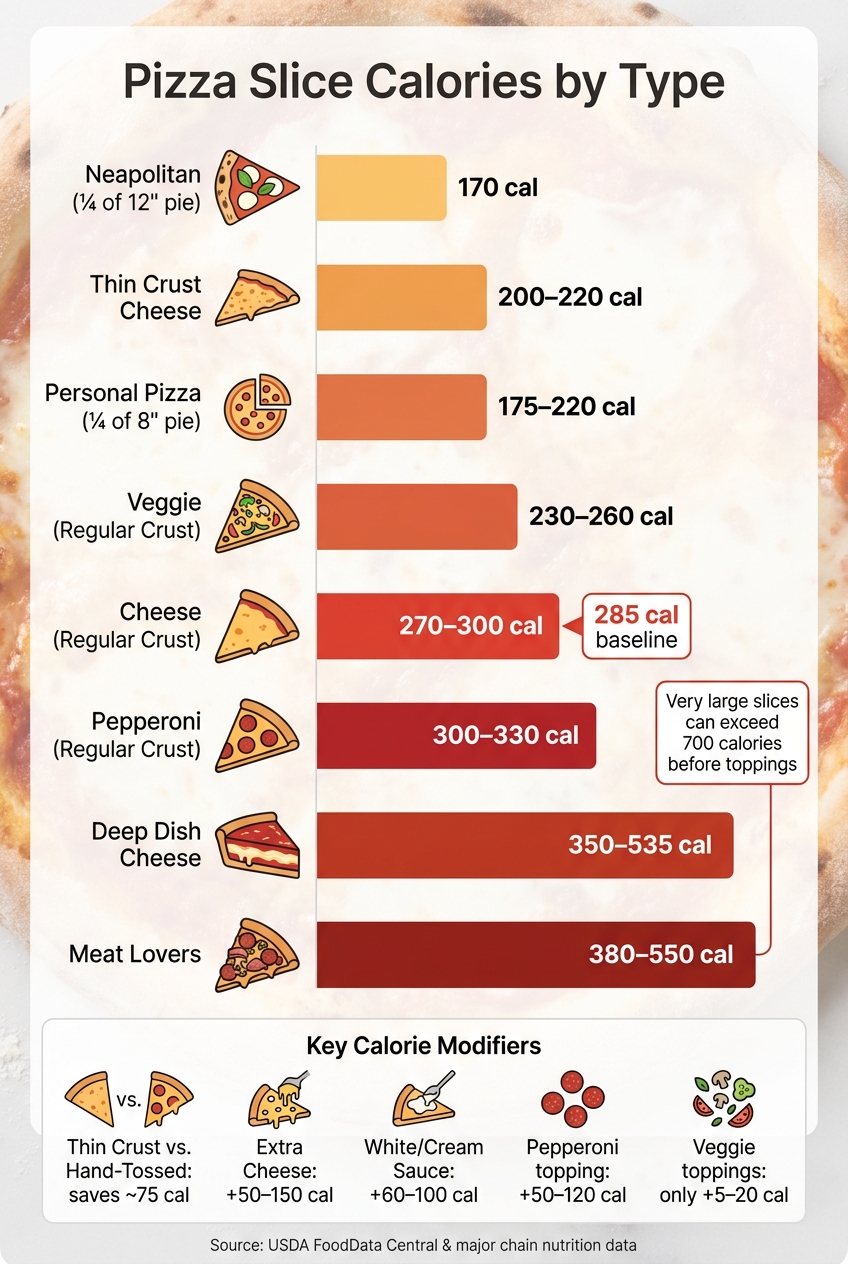
Pizza Slice Calories by Type: A Visual Comparison
Cheese, Pepperoni, and Veggie Slices
Use the 285-calorie cheese slice as the baseline, and the numbers start moving fast.
Cheese, pepperoni, and veggie slices can look similar on the plate, but their calorie totals often split pretty quickly. Compared with the 285-calorie baseline above, pepperoni usually lands higher, while veggie tends to come in lower. Pepperoni often adds 50–150 calories per slice, putting many slices in the 300–330 calorie range. Veggie slices are usually the lightest of the three, at about 230–260 calories.
Deep Dish, Meat-Heavy, Thin Crust, and Personal Pizza Slices
Style changes the range even more. A Neapolitan slice averages about 170 calories, while a Chicago deep-dish slice can top 535 calories.
Thin crust usually falls between 200–220 calories. Less dough means fewer calories. You can see that in chain nutrition data: a large hand-tossed cheese slice has 290 calories, while a large thin-crust cheese slice drops to 215 calories. That's a 75-calorie gap from changing the crust alone.
At the heavy end, meat lovers slices range from 380–550 calories, based on how much meat gets piled on. Personal pizza slices can also add up fast, even though they look smaller, because the serving is often counted as ¼ of an 8" pie.
| Pizza Type | Avg. Calories/Slice | Typical Weight |
|---|---|---|
| Neapolitan (¼ of 12" pie) | 170 | 80–100g |
| Thin Crust Cheese | 200–220 | 80–90g |
| Veggie (Regular Crust) | 230–260 | 110g |
| Cheese (Regular Crust) | 270–300 | 107g |
| Pepperoni (Regular Crust) | 300–330 | 110g |
| Deep Dish Cheese | 350–535 | 300–350g |
| Meat Lovers | 380–550 | 130–150g |
| Personal Pizza (¼ of 8" pie) | 175–220 | 70–90g |
Data compiled from USDA averages and major chain nutrition facts.
Very large slices can exceed 700 calories before toppings.
The next variable is what changes those numbers within each slice.
What Changes the Calorie Count in a Slice of Pizza
Slice Size, Crust Type, and Cheese Amount
How many calories are in a slice of pizza mostly comes down to four things: crust, cheese, toppings, and how the pizza was made. And out of those, crust is often the biggest calorie driver. That’s why two slices can look almost the same but still land at very different calorie totals.
Slice size also plays a big part. There’s no standard serving size for pizza, so one “slice” can mean very different things. A New York slice, for example, can weigh a lot more than a Neapolitan slice.
Cheese changes the math fast. Extra mozzarella, stuffed crust, and cheese-burst styles all push the calorie count up. Light cheese usually cuts it down, often by about 25% less than a standard amount.
Toppings, Preparation Style, and Restaurant Differences
Toppings can swing the number more than people expect. Vegetables add very little, while processed meats, white sauces, and oil-heavy cooking styles add a lot more. Pan and Detroit-style pizzas are baked in oil-lined trays, which adds calories you may not notice just by looking at the slice.
Sauce matters too. Classic tomato sauce usually adds only 10–20 calories per slice. White or Alfredo sauces can add 60–100+ calories per slice. That’s a big jump from one swap alone.
Restaurant pizza also tends to run higher than homemade. More oil, more cheese, and larger portions are often the reason.
| Factor | Typical Calorie Effect | Notes |
|---|---|---|
| Thin Crust | 100–150 kcal base | Lowest dough volume |
| Hand-Tossed Crust | 150–200 kcal base | Standard pizzeria baseline |
| Deep Dish/Pan Crust | 250–400+ kcal base | High dough weight and oil content |
| Veggie Toppings | +5–20 kcal | Mushrooms, peppers, spinach |
| Pepperoni | +50–120 kcal | High fat; very calorie-dense |
| Italian Sausage | +100–140 kcal | Often the heaviest meat option |
| Extra Cheese | +50–150 kcal | ~85 cal per additional ounce |
| White/Cream Sauce | +60–100+ kcal | Alfredo or garlic butter bases |
Here’s one small trick that surprises people: blotting grease off a pepperoni slice with a paper towel can remove about 35–50 calories from that one slice.
These are the main things photo-based calorie estimates look for next.
Using What The Food to Estimate Pizza Calories and Key Takeaways

How AI Photo Analysis Can Estimate Pizza Calories
Pizza calories can swing a lot from one slice to the next. Size, crust, cheese, and toppings all change the number. That’s why manual logging often falls short. Most people underestimate pizza calories by 20% to 40% when logging by hand.
The main problem is simple: it’s hard to judge a slice by eye. A slice might look average, but the crust could be thicker, the cheese heavier, or the toppings more dense than you think.
With What The Food, you can upload a photo and get an estimate based on the pizza style, visible toppings, portion size, and nutrition facts for a slice of pizza. That includes calories, protein, carbs, and fat, without manual logging. Once the photo helps pin down the slice size and style, tracking gets a lot easier. Accuracy gets better when you also add crust type, cheese level, pizza diameter, and slice count.
Key Takeaways for Tracking Pizza Calories
If you’re trying to figure out how many calories are in a slice of pizza, a standard cheese slice from a 14-inch pie usually comes in at about 285 calories. That gives you a solid starting point.
But here’s the catch: slice size matters just as much as the ingredients. The pie’s diameter and the number of slices can change the calorie count more than a quick glance ever could. For faster tracking, use photo analysis to estimate the slice first, then adjust for restaurant style, oil, and cheese density.
FAQs
How accurate is a pizza calorie estimate?
Pizza calorie estimates are often rough guesses because a slice isn’t a standard serving size. A lot of people lowball pizza calories by 20% to 40%.
Here’s the issue: a “slice” can mean very different things. It might be a small Neapolitan piece or a big New York–style slice. That’s a huge swing.
So generic averages can be way off. Crust thickness, cheese amount, and toppings all change the numbers. If you want a better estimate, look at the pizza’s style, size, and ingredients.
Why do pizza slice calories vary so much?
Pizza slice calories vary because a slice isn’t a standard unit. One piece can be small and light, while another can feel like a whole meal on its own.
The total depends on a few main things:
- Slice size and weight
- Crust thickness and composition
- Amount and type of cheese
- Toppings
A thin-crust slice may have about 170 calories, while a deep-dish or large street-style slice can go past 500 to 700 calories. That’s a huge swing.
So yes, one slice might be a light snack. Or it might be the kind of slice that pretty much is lunch.
How can I count pizza calories more accurately?
To count pizza calories with more accuracy, skip the generic averages. Look at the things that change how many calories are in a slice of pizza: crust type, portion size, and toppings.
For restaurant pizza, check the nutrition info on the website or app. For frozen pizza, read the Nutrition Facts panel and pay close attention to the serving size. For homemade pizza, add up each ingredient by weight, then divide the total by the number of slices.
Related Posts
Beginner's Guide to AI-Powered Macro Tracking
Estimate calories, protein, carbs, and fat from meal photos; fix portions and hidden fats, and track weekly trends with AI-assisted logging.
Manual vs AI Food Tracking: Which Method Works Better?
Manual tracking gives near-exact calories; AI photo logging is faster and boosts consistency—often a hybrid approach works best.
How Many Calories Are in Common Fruits? A Complete Guide
Calories in common fruits by serving and per 100 g, plus tracking tips, dried fruit and avocado calorie differences.
MyFitnessPal Vs. WhatTheFood: Which Macro Tracker is Best?
AI meal-photo scanning often beats crowdsourced databases for faster, more accurate macro tracking—compare speed, accuracy, and value.