
Chicken, Eggs & Protein Foods: Calorie and Macro Breakdown
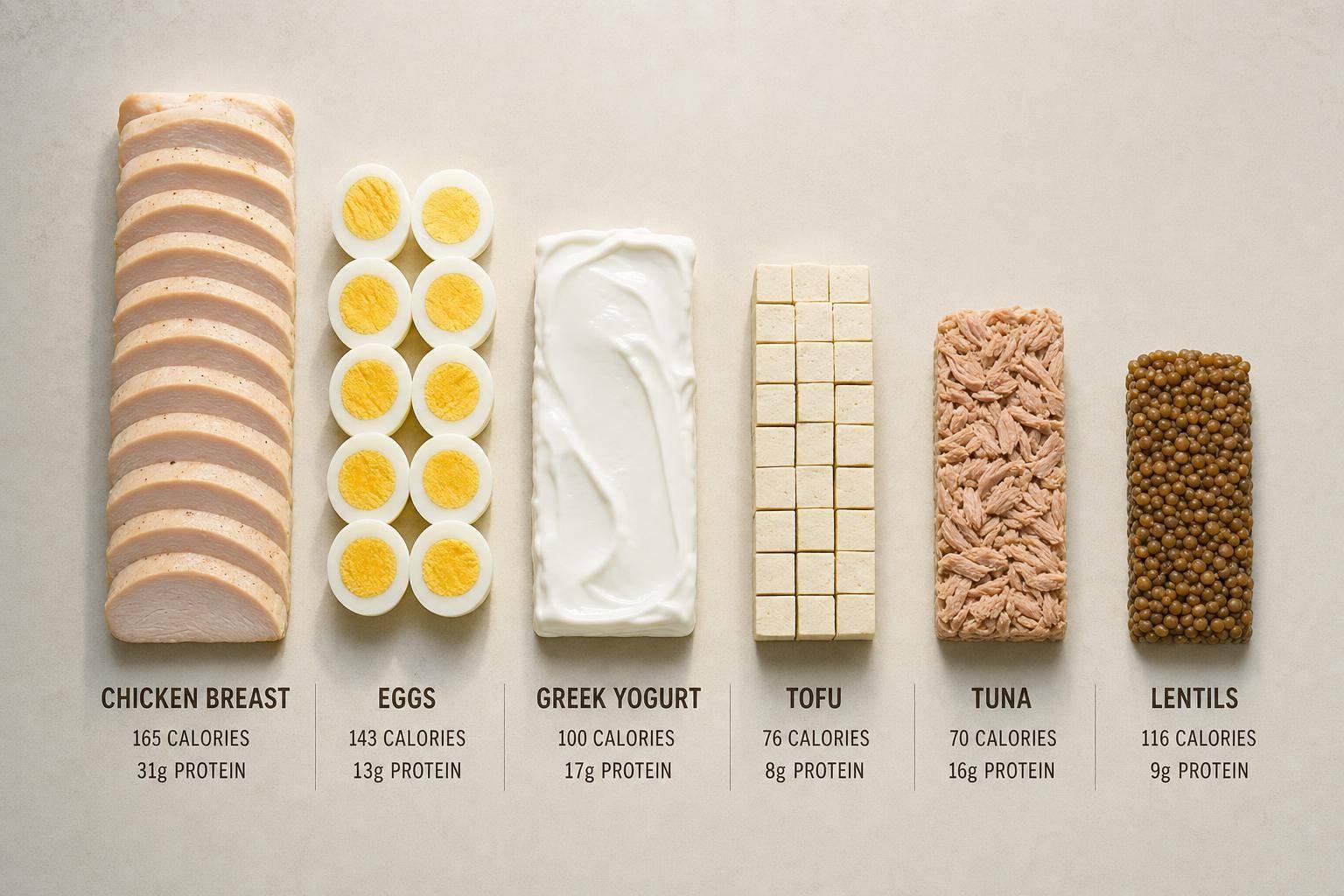
Chicken, Eggs & Protein Foods: Calorie and Macro Breakdown
If I want the short answer: egg whites, chicken breast, and nonfat Greek yogurt give me the most protein for the fewest calories. Bacon is the weakest pick for protein per calorie, and bagels are mostly a carb food.
Here’s the full takeaway in plain English:
- Best lean protein: chicken breast
- Best protein-per-calorie: egg whites
- Best nutrient mix: whole eggs
- Higher-fat meat option: chicken thigh
- Strong dairy picks: Greek yogurt and cottage cheese
- Mostly flavor, not protein: bacon
- Mostly carbs, not protein: bagels
If I’m choosing based on numbers alone, the pattern is simple:
- Chicken breast: about 31g protein per 100g cooked
- Egg whites: about 3.6g protein for just 17 calories each
- Whole eggs: 6.3g protein and 78 calories per large egg
- Nonfat Greek yogurt: 18g protein per 170g
- Cottage cheese: 14g protein per 112g
- Bacon: low protein density, high fat
- Bagels: 50–60g carbs per 100g
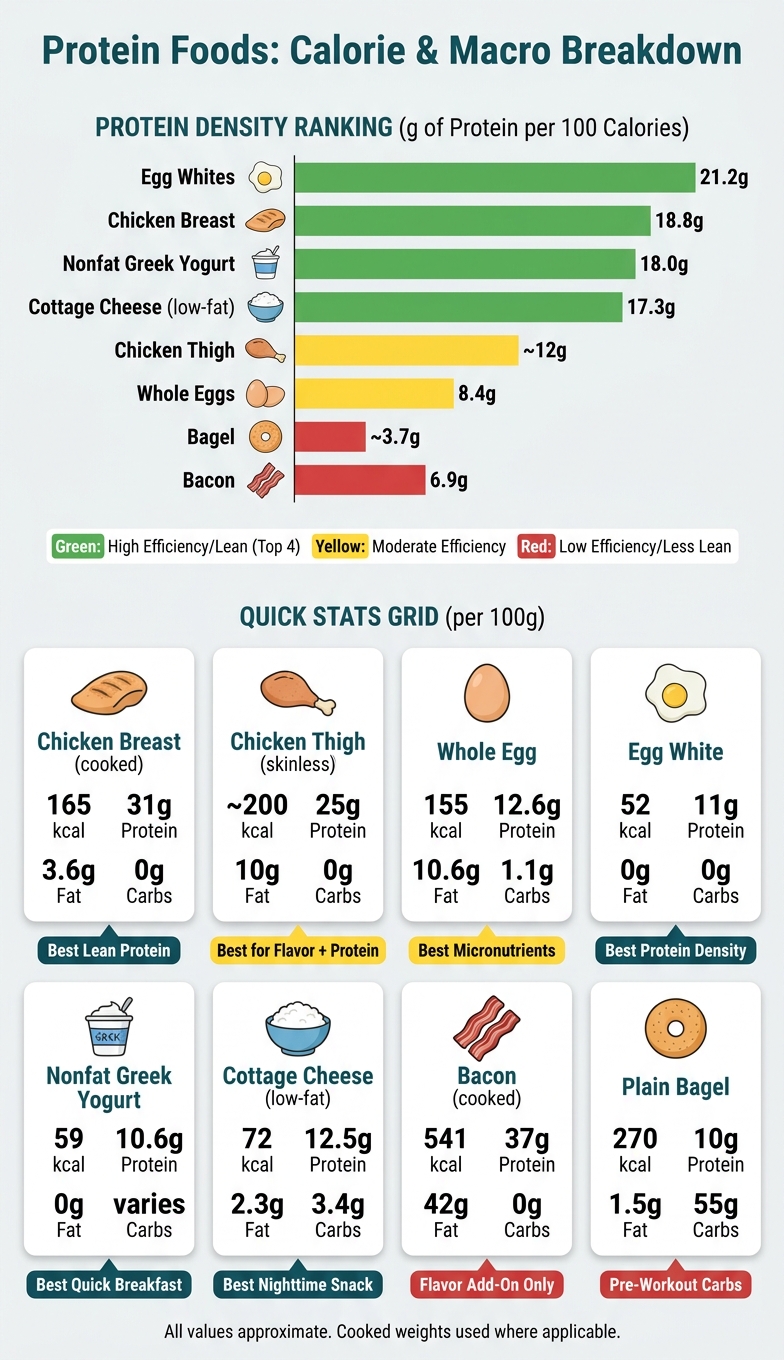
Protein Foods Compared: Calories, Protein & Macro Breakdown
Quick Comparison
| Food | Main Macro Strength | Main Tradeoff | Best Fit |
|---|---|---|---|
| Chicken breast | High protein, low fat | Can dry out | Fat loss, high-protein meals |
| Chicken thigh | Protein with more fat | More calories | Higher-calorie, lower-carb meals |
| Whole eggs | Protein plus choline and vitamin D | More fat than whites | Balanced breakfasts |
| Egg whites | Highest protein density | Few micronutrients | Low-calorie protein |
| Greek yogurt | High protein, low calorie | Dairy, possible added sugar | Breakfast, snacks |
| Cottage cheese | High protein, low calorie | Sodium, texture | Snacks, slow-digesting protein |
| Bacon | Flavor, fat | Low protein per calorie | Small add-on |
| Bagel | High carbs | Weak protein density | Pre-workout fuel, fast carbs |
Bottom line: if my goal is protein efficiency, I’d start with egg whites, chicken breast, and Greek yogurt. If I want more flavor or a more balanced meal, whole eggs and chicken thigh make more sense.
sbb-itb-034be4e
1. Chicken Breast
Chicken breast is the lean baseline in this comparison. A 4 oz cooked, skinless serving gives you 35g of protein and just 187 calories, with 0g of carbs and only 4g of fat. Move up to 6 oz cooked, and you're looking at 53g of protein and 281 calories.
That’s why chicken breast works as the reference point for the fattier cuts coming next.
Calories
Calories per ounce shift after cooking because chicken loses water as it cooks. Raw chicken breast has 120 calories per 100g, while cooked skinless breast has 165 calories per 100g. The reason is simple: less water means the nutrients are more concentrated .
Protein
Cooked chicken breast provides 31g of protein per 100g . It’s a complete protein, which means it contains all nine essential amino acids your body can’t make on its own. It also has about 2.5g of leucine per 100g.
Fat & Carbs
Skinless chicken breast has 0g of carbs and just 3.6g of fat per 100g cooked . Add the skin or cook it with extra fat, and the calories climb fast.
| Preparation (per 4 oz cooked) | Calories | Protein | Fat | Carbs |
|---|---|---|---|---|
| Grilled/Baked (Skinless) | 187 | 35g | 4g | 0g |
| Rotisserie (Skin-on) | 252 | 30g | 14g | 0g |
| Pan-Fried (1 tbsp oil) | 307 | 35g | 18g | 0g |
| Breaded and Fried | 340 | 28g | 18g | 15g |
If you track your food, weigh chicken raw and log it as raw. That helps you avoid the usual confusion that comes from moisture loss during cooking.
This is also why chicken breast gives you the most protein per calorie in this group.
Next, it helps to stack that lean profile against chicken thigh, which stays in the same protein lane but comes with more fat and more calories.
2. Chicken Thigh
Chicken thigh has the same zero-carb, high-protein setup as chicken breast, but it comes with more fat and more calories. It’s darker, richer, and less lean than breast. The trade-off is simple: you get meat that stays juicy and handles longer cooking better. That extra fat is a big reason why.
Calories
A 4 oz cooked, skinless chicken thigh has 232 calories. If you keep the skin on, add about 50 calories and 6 g of fat per 4 oz.
Protein
Skinless chicken thigh gives you about 25 g of protein per 100 g cooked. One boneless, skinless cooked thigh, which weighs about 116 g, delivers roughly 28.8 g of protein.
Fat & Carbs
Chicken thigh has 0 g of carbs and about 8.2 to 10 g of fat per 100 g when skinless. With the skin on, fat climbs to about 15.5 g per 100 g.
Dark meat also gives you more iron and zinc than chicken breast.
| Preparation / Serving Size | Calories | Protein | Fat | Carbs |
|---|---|---|---|---|
| Skinless, cooked (4 oz) | 232 | 28 g | 12 g | 0 g |
| Skin-on, cooked (4 oz) | 280 | 26 g | 18 g | 0 g |
Protein Density
Chicken thigh gets about 55% of its calories from protein. Chicken breast is closer to 80%. So if your goal is max protein for the fewest calories, breast comes out ahead.
Thigh makes more sense when you want a higher-fat, low-carb option that still brings plenty of protein. And if you’re comparing it with eggs, you’re looking at a different macro mix altogether.
3. Whole Eggs
Whole eggs give you complete protein, but the yolk changes the nutrition math. It adds fat and calories, and it also brings nutrients like choline and vitamin D.
Calories
One large egg has 78 calories, whether it's boiled, poached, or raw. If you cook it with butter or oil, the total goes up fast. That added fat usually adds about 50–70 calories per serving.
Protein
A large egg provides 6.3g of complete protein and has a PDCAAS of 1.0. In plain English, it has all the amino acids your body needs in a form it can use well. That's what sets up the comparison with egg whites in the next section.
Fat & Carbs
Whole eggs contain 0.6g of carbs and 5.3g of fat per egg. Cook them in butter or oil, and both calories and fat climb quickly.
On a 100g basis, here's how the numbers compare:
| Preparation | Calories (per 100g) | Protein | Fat | Carbs |
|---|---|---|---|---|
| Raw / Boiled / Poached | 155 kcal | 12.6–13g | 10.6–11g | 1.1g |
| Fried in Butter | 210+ kcal | ~13g | 16g+ | ~1.1g |
| Scrambled in Oil | 200–220 kcal | ~13g | 15g+ | ~1.1g |
Protein Density
Whole eggs offer about 0.084g of protein per calorie. That's lower than chicken breast, which comes in at 0.188g/cal. So while eggs are a solid protein food, they aren't as lean on a calorie-for-protein basis.
Most of the egg's choline and vitamin D sit in the yolk. One large egg gives you 147mg of choline, which covers 27% of the Daily Value for women and 23% for men. That matters because if you skip the yolk, you keep the protein but lose most of those nutrients.
A large egg also has about 186mg of cholesterol, though dietary cholesterol has a small effect on LDL for most people.
Next, egg whites keep the protein while cutting out most of the fat and calories.
4. Egg Whites
Take away the yolk, and egg whites keep the protein while dropping most of the fat and calories. They’re made up mostly of water and protein, so they’re a lean pick when you want protein without much fat or cholesterol.
Calories
One large egg white has 17 calories, compared with 78 calories in a whole egg. Eat four egg whites, and you get 68 calories and 14.4g of protein.
Protein
Each large egg white gives you 3.6g of protein, and egg protein has a PDCAAS of 1.0. In plain English, that means your body can use it well, and it includes all essential amino acids.
For a simple low-calorie option, three egg whites provide 10.8g of protein for 51 calories.
Fat & Carbs
Egg whites have 0g of fat and 0g of carbs. The catch is pretty simple: most of the micronutrients in eggs live in the yolk, so egg whites have very little choline and vitamin D.
Protein Density
This is where egg whites shine. One egg white gives you about 0.21g of protein per calorie, and close to 85% to 90% of its calories come from protein.
| Serving | Calories | Protein | Fat | Carbs |
|---|---|---|---|---|
| 1 Large Egg White | 17 kcal | 3.6g | 0g | 0g |
| 3 Large Egg Whites | 51 kcal | 10.8g | 0g | 0g |
| 4 Large Egg Whites | 68 kcal | 14.4g | 0g | 0g |
| 100g Egg White | ~52 kcal | ~11g | 0g | 0g |
Next, cottage cheese offers another high-protein option with a different fat and carb profile.
5. Low-Fat Greek Yogurt
Low-fat Greek yogurt is one of the leanest dairy protein picks on this list. Plain, nonfat Greek yogurt has 18g of protein and 100 calories per 170g serving, or about ¾ cup. That puts it surprisingly close to chicken breast in protein density, just in dairy form.
Calories
A 170g serving of plain, nonfat Greek yogurt has 100 calories. Per 100g, that comes out to about 59 calories.
Protein
With 18g of protein per serving, nonfat Greek yogurt gives you a lot of protein for not many calories. If you're shopping, plain options with 15–18g of protein per serving are a good target.
Fat & Carbs
Because it's plain and nonfat, Greek yogurt stays very low in fat. The main thing to check is added sugar. Total sugar on the label can also include natural lactose, so plain versions are the safer bet if you want to keep things simple. That makes Greek yogurt a strong high-protein choice when you want low fat but don't want to eat egg whites.
| Serving | Calories | Protein | Protein Density |
|---|---|---|---|
| 170g (plain, nonfat) | 100 kcal | 18.0g | 0.180 |
| 100g (plain, nonfat) | ~59 kcal | ~10.6g | 0.180 |
Greek yogurt also provides about 62mg of choline per cup. Cottage cheese comes next with a similar protein amount and a slightly different calorie split.
6. Cottage Cheese
Cottage cheese is one of those foods that looks simple on the surface, but the label can change the numbers quite a bit. It’s a high-protein dairy pick with a pretty clean macro setup. You’ll usually see nonfat, 1%, 2%, and 4% versions, so it pays to check the fat percentage before you buy. And if you want the numbers to stay predictable, go with plain cottage cheese. Flavored versions can shift the macros.
After Greek yogurt, cottage cheese keeps the dairy protein comparison going, though it has a bit less protein per calorie.
Calories
A standard 112g serving of low-fat cottage cheese has 81 calories. So if you want something light that still gives you a solid amount of protein, it fits the job well.
Protein
That same 112g serving gives you 14.0g of protein.
Fat & Carbs
Low-fat (2%) cottage cheese has about 2.3g of fat and 3.4g of carbs per 112g serving. Nonfat versions cut fat to under 0.5g, while full-fat (4%) versions bring it closer to 5g per serving.
Protein Density
Low-fat cottage cheese provides 0.173g of protein per calorie. That puts it just under nonfat Greek yogurt (0.180) and chicken breast (0.188).
| Serving | Calories | Protein | Protein Density |
|---|---|---|---|
| 112g (low-fat) | 81 kcal | 14.0g | 0.173 |
Next comes bacon, where the macro balance shifts toward more fat.
7. Bacon
After the lean dairy picks, bacon changes the comparison in a big way. Here, the story isn’t protein density. It’s fat, sodium, and taste. Compared with cottage cheese, bacon gives up a lot of protein-per-calorie in exchange for a richer, fattier bite.
Two cooked slices of bacon, about 16 g each or 32 g total, provide roughly 87 calories, 6 g of protein, 7 g of fat, and 0 g of carbs. Per calorie, that comes out to about 0.069 g of protein per calorie. That’s much lower than chicken breast at 0.188 g/cal, Greek yogurt at 0.180 g/cal, and cottage cheese at 0.173 g/cal.
| Serving | Calories | Protein | Fat | Carbs | Protein Density |
|---|---|---|---|---|---|
| 2 cooked slices (~32 g) | 87 kcal | 6 g | 7 g | 0 g | 0.069 |
| 100 g cooked | ~541 kcal | ~37 g | ~42 g | 0 g | 0.068 |
Put simply, bacon is the least lean food in this guide. It’s high in fat, high in sodium, and it has the lowest protein-per-calorie ratio of any option listed here.
Next, bagels swing the macro split again, this time toward carbs.
8. Bagel
After bacon’s fat-heavy profile, bagels push this comparison in the other direction. A plain bagel is mostly about carbs. Because it’s made from refined wheat flour, it packs a dense load of starch.
Protein
A 100 g plain bagel has about 9 to 11 g of protein. That’s more than many breads, which might sound decent at first.
But next to foods like chicken, eggs, yogurt, and cottage cheese, it’s not even close. Bagels give up protein density in exchange for a much bigger carb load.
Fat & Carbs
Bagels are low in fat, with about 1 to 2 g per 100 g. One 100 g bagel usually delivers 50 to 60 g of carbs.
| Serving | Calories | Protein | Fat | Carbs |
|---|---|---|---|---|
| 100 g | ~270 kcal | ~9 to 11 g | ~1 to 2 g | ~50 to 60 g |
That makes bagels handy when you want quick energy, not when your main goal is getting the most protein for your calories.
Protein Density
Bagels do have some protein, but they’re nowhere near as protein-dense as the foods listed above. At the end of the day, a bagel is mostly a carb food. It works well for carbs, not for protein density.
What the Numbers Show
Once you line up the head-to-head comparisons, three things jump out: protein density, serving size, and how the food is cooked.
Egg whites come out on top for protein density at about 21.2g of protein per 100 calories, with chicken breast and nonfat Greek yogurt right behind them.
Chicken breast wins on total protein per serving. One cooked breast (174g) gives you about 56g of protein - more than any other food in this comparison.
Cooking method can swing the macros fast. Dry heat helps keep calories lower. Add oil or breading, and fat or carbs can climb in a hurry.
| Category | Winner | Key Reason |
|---|---|---|
| Best lean protein | Chicken Breast | About 31g protein and 165 calories per 100g; roughly 80% of calories come from protein |
| Strongest protein density | Egg Whites | ~21.2g protein per 100 calories |
| Best quick breakfast protein | Egg Whites / Greek Yogurt | High protein density, low fat, and easy to prepare |
| Highest fat tradeoff | Chicken Thigh | Fat becomes the dominant macro |
| Highest carb tradeoff | Bagel | High-carb, low-protein option with a lot of energy per serving |
| Best micronutrient profile | Whole Egg | Choline, vitamin D, selenium, and nearly all the micronutrients are in the yolk |
Bacon and bagels land on opposite ends of the spectrum. Whole eggs sit in the middle: more balanced, more filling, and packed with nutrients. From here, the pros and cons by food make it easier to match each option to a specific goal.
Pros and Cons by Food
Here are the day-to-day tradeoffs behind those calorie and macro numbers. Macros matter on paper, sure. But they matter even more once food hits an actual plate.
Use the table below to line up each food with your macro target.
| Food | Pros | Cons | Best Use Case |
|---|---|---|---|
| Chicken Breast | Lean; more filling for the calories | Can be dry and bland | Strict cutting; maximum protein goals |
| Chicken Thigh | Better flavor; stays juicier; budget-friendly | Fat-heavy compared to breast | Higher-calorie meals; keto-friendly meal prep |
| Whole Eggs | Complete protein; nutrient-dense | Higher fat and cholesterol per serving | Balanced breakfast |
| Egg Whites | Nearly pure protein; very low calorie | Removes most egg micronutrients | Extreme calorie restriction; volume eating |
| Low-Fat Greek Yogurt | Easy, no-cook protein; high protein efficiency | Contains dairy; may contain added sugars | Quick high-protein snacks; post-workout; breakfast |
| Cottage Cheese | Casein protein; easy to pair with sweet or savory foods | High sodium; texture can be polarizing | Nighttime snack; muscle maintenance |
| Bacon | High flavor impact; keto-friendly in small amounts | More fat than protein; processed; high sodium | Flavor add-on; used sparingly in keto |
| Bagel | Fast carb energy; easy to grab | High calories for modest protein | Pre-workout carb fuel |
A simple way to think about it: bacon adds taste, bagels add carbs. Neither should do the heavy lifting if your main goal is protein.
Conclusion
If you look at protein per calorie, the standouts are pretty obvious. Chicken breast, egg whites, and low-fat Greek yogurt give you the most protein for the fewest calories in this group.
Chicken thighs and whole eggs cost you more calories, but they bring more flavor and can feel more filling. That makes them a better fit for higher-calorie or lower-carb meals. Whole eggs also provide nutrients like choline and vitamin D that you won't get from whites alone.
On the dairy side, cottage cheese is a flexible, high-protein pick that works in all kinds of meals and snacks.
Bacon and bagels make more sense as extras. Bacon adds flavor. Bagels add carbs. But neither should do the heavy lifting if you're trying to hit a daily protein goal.
The pattern here is simple: lean foods give you the best efficiency, while the others serve specific roles. Bottom line: choose based on your calorie budget, serving size, and protein target.
FAQs
Which protein food is best for fat loss?
Chicken breast is one of the top picks for fat loss. A 100 g cooked serving has about 165 calories and 31 g of protein.
Chicken thighs are a bit higher in calories. A 100 g cooked serving has about 177–179 calories and around 25 g of protein.
Egg whites are another very lean option at 17 calories and 3.6 g of protein per egg white. Whole eggs bring more nutrients to the table, so they can still fit well depending on your goals.
Nonfat Greek yogurt and low-fat cottage cheese are also solid choices if you want a lot of protein without a big calorie hit.
One thing that often gets missed: cooking fats count fast. Butter or oil can push the total calorie amount up more than people expect.
Are whole eggs healthier than egg whites?
It depends on your goal. Whole eggs give you 78 calories, 6.3g of protein, and 5.3g of fat. You also get the yolk, which contains choline and vitamins.
Egg whites, on the other hand, give you 3.6g of mostly pure protein.
If you want more nutrients, whole eggs are the better pick. If you want mostly protein with fewer calories and less fat, egg whites make more sense.
Does cooking method change chicken calories?
Cooking can change calories per serving because chicken loses water as it cooks. That means the raw weight and cooked weight won’t match. A 6 oz raw chicken breast, for example, may shrink to about 4.5 oz after cooking.
Here’s the key point: the chicken didn’t suddenly gain calories. It just got smaller as moisture cooked off. So if you compare raw and cooked portions without accounting for that weight loss, the numbers can look off.
Per 100 g cooked:
- Chicken breast: about 165 calories and 31 g of protein
- Chicken thighs: about 177–179 calories and 25 g of protein
Related Posts
Beginner's Guide to AI-Powered Macro Tracking
Estimate calories, protein, carbs, and fat from meal photos; fix portions and hidden fats, and track weekly trends with AI-assisted logging.
Manual vs AI Food Tracking: Which Method Works Better?
Manual tracking gives near-exact calories; AI photo logging is faster and boosts consistency—often a hybrid approach works best.
How Many Calories Are in a Slice of Pizza?
Typical cheese slice ≈285 kcal; slices range 170–700+. Size, crust, cheese, toppings and sodium drive the calorie difference.
Vegetable & Legume Calorie Guide: From Sweet Potato to Chickpeas
Calorie and nutrient comparisons for common vegetables, legumes, and seeds, plus how cooking and toppings change totals.