
Vegetable & Legume Calorie Guide: From Sweet Potato to Chickpeas
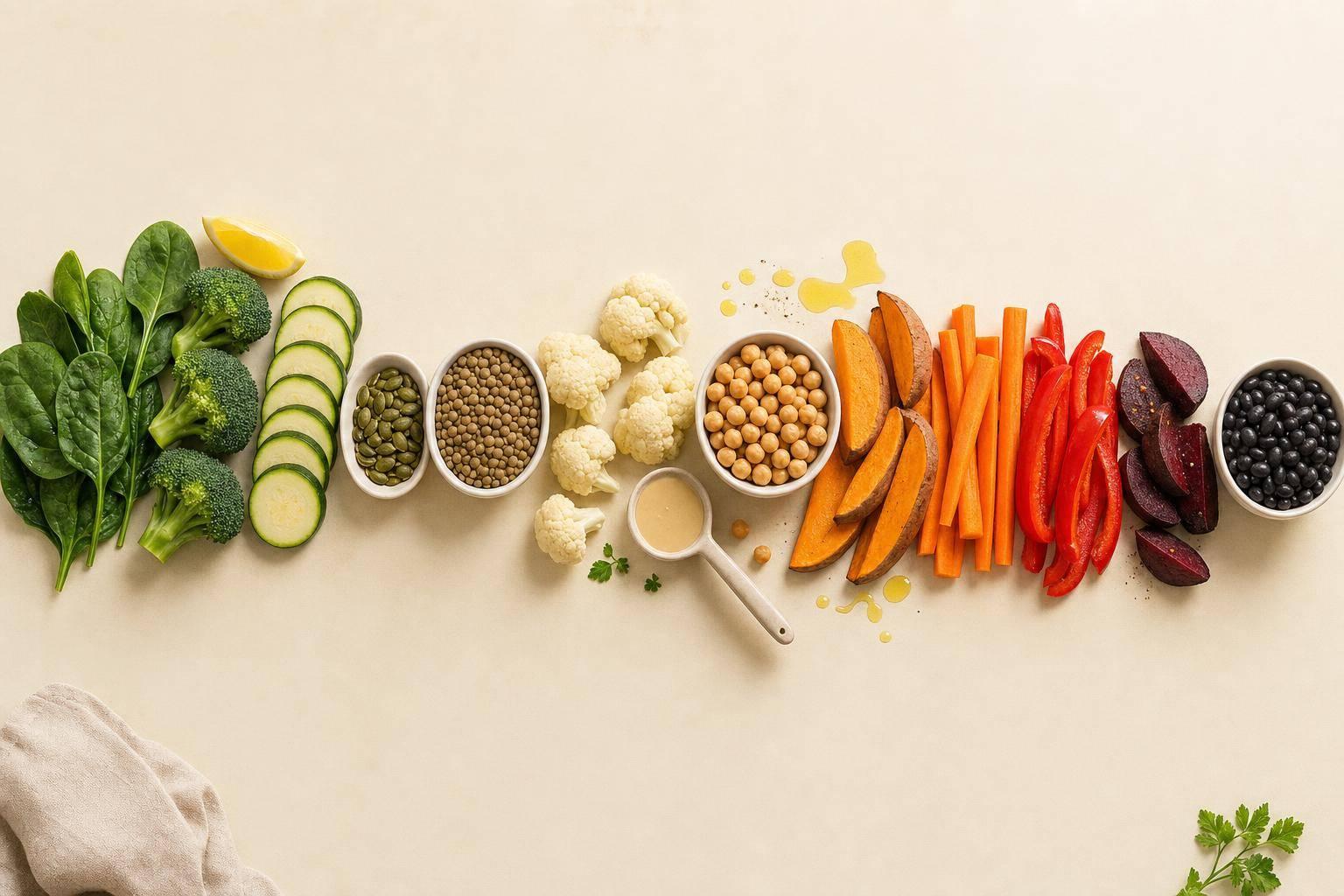
Vegetable & Legume Calorie Guide: From Sweet Potato to Chickpeas
Calories swing fast with plant foods. A cup of cucumber is about 16 calories, while a cup of cooked chickpeas is about 269. And small add-ons matter too: 1 tbsp of olive oil adds about 120 calories.
If I wanted the whole article in a few lines, I’d put it like this:
- Non-starchy vegetables like lettuce, cucumber, tomatoes, bell peppers, broccoli, and carrots are the lightest picks.
- Starchy vegetables like sweet potato, baked potato, and corn land in the middle.
- Legumes and seeds like chickpeas, lentils, edamame, quinoa, and chia pack more protein, fiber, and calories per serving.
- Cooking and toppings can shift totals by 10% to 20%, and eyeballing portions can miss by 20% to 50%.
- The biggest calorie jumps usually come from butter, oil, cheese, sour cream, ranch, and bacon.
Here are the foods covered in this guide:
- Sweet potato
- Baked potato
- Corn on the cob
- Chickpeas
- Lentils
- Edamame
- Quinoa
- Chia seeds
- Bell pepper
- Broccoli
- Carrots
- Cucumber
- Tomatoes
- Lettuce
Bottom line: if you want more volume for fewer calories, stick with watery vegetables. If you want more protein and fiber, legumes do more work but cost more calories. And if you want your tracking to stay close, log foods by raw or cooked weight that matches the database entry.
🥦Calories in Vegetables🍅🥕Full Guide to Veggie Nutrition⚡
sbb-itb-034be4e
Quick Comparison
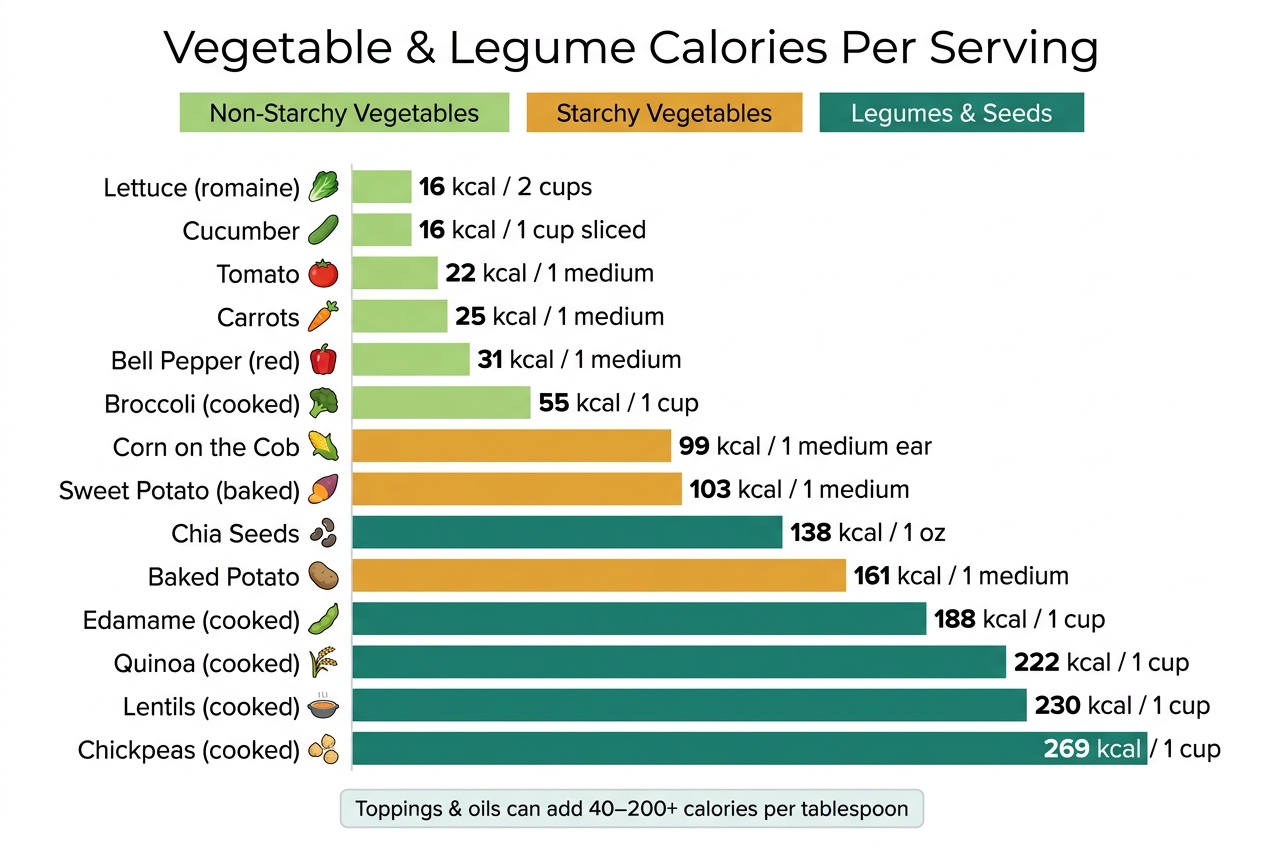
Vegetable & Legume Calorie Comparison Chart
| Food | Standard Serving | Calories | Main Takeaway |
|---|---|---|---|
| Sweet potato | 1 medium baked | 103 | Mid-range starch with fiber and vitamin A |
| Baked potato | 1 medium | 161 | Plain potato is moderate; toppings change it fast |
| Corn on the cob | 1 medium ear | 99 | Lighter starch, but butter adds up fast |
| Chickpeas | 1 cup cooked | 269 | Higher-calorie legume with strong fiber |
| Lentils | 1 cup cooked | 230 | High fiber and high protein |
| Edamame | 1 cup cooked | 188 | Best low-carb legume in the group |
| Quinoa | 1 cup cooked | 222 | Grain-like seed with moderate calories |
| Chia seeds | 1 oz dry | 138 | Small portion, dense in calories and fiber |
| Bell pepper | 1 medium | 24–31 | Very low calorie, high in vitamin C |
| Broccoli | 1 cup cooked | 55 | Low calorie with more fiber than most veggies |
| Carrots | 1 medium | 25 | Low calorie, high in vitamin A |
| Cucumber | 1 cup sliced | 16 | One of the lightest foods here |
| Tomatoes | 1 medium | 22 | Low calorie with lycopene and vitamin C |
| Lettuce | 2 cups romaine | 16 | Lowest-calorie base for salads and wraps |
So before I look at any one food, I’d start with this rule: the base food matters, but the oil, dressing, and toppings often matter more.
How to Use This Calorie Guide
Each entry shows calories, fat, carbs, fiber, sugars, protein, sodium, potassium, plus key vitamins and minerals. That lets you compare fullness and nutrient density fast, without digging through extra notes.
The foods are grouped by meal role since they often show up as the main starch or a side on the plate. In plain terms, that makes the guide easier to scan when you need a side dish, snack, or base for a meal.
Cooking can change calorie totals fast. Roasting increases calorie density as water cooks off. Boiling can lower calories per gram. Frying can add 50–200+ calories from absorbed oil. And with potatoes or corn, toppings can end up adding more calories than the food itself.
When you can, weigh foods raw. If not, match cooked weights to cooked database entries. All values are approximate, so start with sweet potato and then compare the rest by serving size and how they were prepared.
1. Sweet Potato
Sweet potato is a solid baseline because it’s filling, easy to cook in different ways, and simple to compare across prep methods. That’s why it works well as the first benchmark food in this list.
A medium baked sweet potato, about 4–5 oz (114–130 g), has around 103 calories. Raw sweet potato comes in a bit lower at 86 calories per 100 g. Baked sweet potato with skin has about 90 calories per 100 g, mostly because cooking lowers the water content.
| Preparation | Weight | Calories |
|---|---|---|
| Raw | 100 g | 86 kcal |
| Baked with skin | 100 g | 90 kcal |
| Medium baked | 114–130 g | 103 kcal |
| Large baked | 180 g | 162 kcal |
Sweet potatoes are also very low in fat. A medium potato has less than 0.2 g. On top of that, one medium baked sweet potato gives you about 4 g of dietary fiber, along with vitamin A, vitamin C, and potassium. That fiber helps with fullness and digestion.
The big swing in calories usually comes from what you put on top. 1 tablespoon of butter adds 102 calories, 1 tablespoon of maple syrup adds 52, and 1 tablespoon of honey adds 64. In plain English: the toppings can outpace the potato fast. That makes sweet potato a useful starting point before looking at baked potato, which begins in a similar range but tends to shift more with size and toppings.
2. Baked Potato
A baked potato is a handy food to compare with a sweet potato. It’s about the same size, but people often load it up with extras. A medium baked potato with skin, about 6 oz (173 g), has 161 calories, 37 g of carbs, 4.3 g of protein, and 4 g of fiber. Most of that fiber comes from the skin. It’s also fat-free and cholesterol-free. On top of that, it gives you a good amount of potassium, vitamin C, and vitamin B6.
On its own, a baked potato is pretty light in calories. The big shift comes from toppings. That’s where the total can climb fast. Add 1 tbsp of butter (+102 cal), 2 tbsp of sour cream (+59 cal), 1 oz of cheddar (+114 cal), and 3 slices of bacon (+129 cal), and that 161-calorie potato jumps to about 565 calories. Same potato, very different meal.
If you want the creamy feel without as many calories, use salsa or nonfat Greek yogurt in place of sour cream.
| Item | Serving Size | Calories |
|---|---|---|
| Plain baked potato (with skin) | 1 medium (173 g) | 161 kcal |
| Oil brushed on skin | 1 tsp oil | +40 kcal |
| Butter | 1 tbsp (14 g) | +102 kcal |
| Sour cream | 2 tbsp (30 g) | +59 kcal |
| Cheddar cheese | 1 oz (28 g) | +114 kcal |
| Bacon (cooked) | 3 slices (24 g) | +129 kcal |
Track the cooked weight, since baking changes water content. Corn on the cob lands in a similar calorie range, but once butter goes on, the total moves up fast.
3. Corn on the Cob
Corn on the cob can look like a light side dish, but the calorie count can climb fast once you add butter or oil. Like baked potatoes, corn is a starchy side, which means it has more calories than leafy greens.
Size matters here. A small ear of corn, about 90 g, has 77 calories and 2 g of fiber. A medium ear, around 103 g, has 99 calories. A large ear, about 225 g, can hit 150 calories. Corn also gives you carbohydrates, fiber, and B vitamins, with vitamin B6 standing out.
The extras make a big difference. A 5 g pat of butter adds 34 calories. A tablespoon of olive oil adds 119 calories. That’s a pretty big jump for such a small amount.
Cooking method changes the numbers too. Raw yellow corn has 86 calories per 100 g, while boiled yellow corn has 96 calories per 100 g. If you're tracking boiled corn, weigh it after cooking so the nutrition data lines up.
| Serving | Size | Calories | Fiber |
|---|---|---|---|
| Small ear | 90 g | 77 kcal | 2 g |
| Medium ear | 103 g | 99 kcal | - |
| Large ear | 225 g | 150 kcal | - |
| Yellow corn, raw | 100 g | 86 kcal | - |
| Yellow corn, boiled | 100 g | 96 kcal | - |
| Butter (topping) | 1 pat (5 g) | +34 kcal | 0 g |
| Olive oil (topping) | 1 tbsp (14 ml) | +119 kcal | 0 g |
Next up is chickpeas, where protein and fiber go up fast.
4. Chickpeas
Chickpeas give you a different nutrition profile than the starchier sides above. They pack more protein and fiber per cup, which makes them feel a bit more filling for the calories.
One cup of cooked chickpeas, or about 164 g, has 269 calories. That same serving gives you 14–15 g of protein and 12–12.5 g of fiber. That’s close to half of the daily fiber target for many adults in just one serving.
You also get 45 g of carbohydrates, 4.7 mg of iron, and 282 mcg of folate per cup. Chickpeas are a solid plant-based iron source. If you want to get more from that iron, eat them with foods like bell peppers or broccoli, which can help your body absorb it better.
| Serving Size (Cooked) | Calories | Protein | Fiber | Carbs |
|---|---|---|---|---|
| 1/4 cup | ~67 kcal | ~3.5 g | ~3 g | ~11 g |
| 1/2 cup | ~135 kcal | ~7 g | ~6 g | ~22.5 g |
| 1 cup (164 g) | 269 kcal | 14–15 g | 12–12.5 g | 45 g |
| Standard 15-oz can (about 1.5 cups drained) | ~404 kcal | ~21 g | ~18 g | ~67.5 g |
One detail matters here: dry chickpeas are far more calorie-dense than cooked chickpeas because they soak up 2–3 times their weight in water during cooking. Once cooked, chickpeas have about 164 calories per 100 g.
If you buy them canned, drain and rinse them to cut down on sodium.
Next up: lentils, another high-fiber legume with a similar calorie profile.
5. Lentils
Lentils edge out chickpeas on protein. One cup of cooked lentils (198 g) gives you 18 g of protein, compared with about 15 g in chickpeas. That same serving also has 230 calories, 40 g of carbohydrates, and 15–16 g of fiber. So if you want a plant food that pulls double duty on both protein and fiber, lentils are hard to beat in this guide.
They also bring a lot to the table beyond macros. Lentils are a strong source of folate and plant-based iron. To help your body absorb more of that iron, eat them with foods like tomatoes, bell peppers, or broccoli.
One thing to watch: dry and cooked lentils are VERY different in calorie density. Dry lentils have 314–321 calories per 100 g, while cooked lentils have 116 calories per 100 g. That gap comes down to water. Once lentils are boiled, they soak up water and weigh more, so the calories per 100 g drop. If you're tracking intake, log them either by dry weight before cooking or by using a cooked entry after boiling.
| Serving Size | Calories | Protein | Fiber |
|---|---|---|---|
| 100 g dry | 314–321 kcal | - | - |
| 1 cup cooked (198 g) | 230 kcal | 18 g | 15–16 g |
| 100 g cooked | 116 kcal | - | - |
Green and red lentils are close in calories and protein. Green lentils have a bit more fiber, while red lentils cook faster and break down more during cooking. Next: edamame, another legume with a different mix of calories, protein, and fiber.
6. Edamame
Edamame is a young soybean. You’ll usually find it fresh or frozen, not dried like beans or lentils. It sits in that in-between spot: more protein-heavy than most vegetables, but not as heavy as dried legumes.
A standard 1-cup serving of edamame (155 g) has 188 calories, 18 g of protein, about 14 g of carbs, and 8.1 g of fiber. That gives you more protein per cup than chickpeas, while still keeping calories in a moderate range for a legume.
Edamame also brings 482 mcg of folate and 3.5 mg of iron per cup. If you want to get more from that plant-based iron, eat it with foods rich in vitamin C.
Frozen edamame has about 109 calories per 100 g, while boiled edamame has about 121. To keep the total lower, steam it or stir-fry it with a small amount of oil. That makes edamame a useful middle ground before moving to the more calorie-dense plant foods that follow.
| Preparation | Calories per 100 g | Serving Size | Calories per Serving |
|---|---|---|---|
| Frozen | 109 kcal | 1 cup (118 g) | 129 kcal |
| Shelled, cooked | - | 1 cup (155 g) | 188 kcal |
7. Quinoa
Quinoa is a grain-like seed, but most people use it the same way they use rice or other grains. In this guide, it lands somewhere between legumes and seeds when you look at calories.
One cup of cooked quinoa (185 g) has 222 calories, or 120 calories per 100 g. That same cup also gives you 5 g of fiber, along with B vitamins.
There’s a big gap between dry and cooked quinoa, which makes sense once you think about how much water it absorbs. Dry quinoa has 306 calories per 100 g, while cooked quinoa drops to 120 calories per 100 g.
If you want to keep the calorie count lower, cook quinoa in plain water. Adding olive oil while it cooks can push the total up fast, since olive oil adds about 119 calories per tablespoon.
Next, chia seeds show how fast calories can climb in much smaller plant foods.
| Quinoa Form | Calories per 100 g | Calories per Cup (185 g) | Fiber per Cup |
|---|---|---|---|
| Dry | 306 kcal | N/A | N/A |
| Cooked (Plain) | 120 kcal | 222 kcal | 5 g |
8. Chia Seeds
After quinoa, chia seeds are another food where calories stack up FAST in a small portion. Just 1 oz (28 g), or about 2 tablespoons, contains about 138 calories and 10 g of fiber.
The biggest logging mistake usually happens after soaking. Once chia seeds absorb water, they swell and take up more space. That changes their volume and lowers the calorie density per gram, but it does not change the seeds’ base calories. If you want the most accurate count, weigh chia seeds dry before soaking.
| Preparation Method | Effect on Calories | Best Tracking Approach |
|---|---|---|
| Soaked in water | No change to base calories; lower calorie density per gram | Weigh dry before soaking |
| Chia pudding (with milk/sweetener) | Increases based on added ingredients | Track milk, juice, and sweeteners separately |
| Added to a smoothie | Increases with total ingredients | Log seeds as a dry add-in |
| Measured by eye | Often leads to undercounting | Use a scale for the dry seeds |
Next up is bell pepper, a low-calorie vegetable that adds crunch and vitamin C.
9. Bell Pepper
After starchier sides like corn, bell peppers are a much lighter pick. They have fewer calories and more vitamin C.
Bell peppers are among the lowest-calorie vegetables you can eat. A medium green pepper has 24 calories, while a medium red pepper has 31. That small gap comes down to ripeness. Red peppers are fully ripe, so they have a bit more natural sugar and slightly more calories than green peppers.
A medium bell pepper gives you 7 g of carbs, 2 g of fiber, 4 g of sugar, and about 190% of the Daily Value for vitamin C. Red peppers also have lycopene and beta-carotene, antioxidants that show up in much smaller amounts in green peppers.
| Serving Size | Green Bell Pepper (Raw) | Red Bell Pepper (Raw) |
|---|---|---|
| 100 g | 20 kcal | 26–31 kcal |
| 1 medium (~119 g) | 24 kcal | 31 kcal |
The part that changes things is cooking. Steaming, grilling, or baking doesn't add calories to the pepper itself. But oil can change the math fast. Roasting with 1 teaspoon of oil adds about 40 calories, and frying can tack on 50–200+ calories based on how much oil the pepper absorbs.
If you're tracking food closely, weigh peppers raw before cooking. Cooking mostly changes water content, not the calorie count.
Next, broccoli shows just how low calories can go in another non-starchy vegetable.
10. Broccoli
Broccoli is one of the lowest-calorie vegetables in this guide. One cup of raw, chopped broccoli has 31 calories, while one cup cooked has 55 calories. That cooked serving looks higher mainly because cooked broccoli takes up less space in the cup. So if you want a low-calorie side, broccoli beats a starch-heavy vegetable pretty easily.
One cup of cooked broccoli also gives you 5 grams of fiber, plus vitamin C, vitamin K, and folate. And there’s a nice bonus here: vitamin C helps your body absorb iron from foods like lentils and beans.
| Serving Size | State | Calories |
|---|---|---|
| 1 cup (about 90 g) | Raw, chopped | 31 kcal |
| 1 cup (156 g) | Cooked | 55 kcal |
| 100 g | Raw | 34 kcal |
| 100 g | Cooked | 35 kcal |
What changes the calorie count fast isn’t the broccoli. It’s what goes on top. A tablespoon of olive oil adds 119–124 calories, an ounce of cheddar cheese adds 113–114 calories, and two tablespoons of ranch dressing adds 129–137 calories.
Next: carrots, another low-calorie vegetable with a different nutrient profile.
11. Carrots
Carrots are low in calories and packed with vitamin A. A medium raw carrot, about 61 g, has 25 calories. A 7-inch carrot has about 35 calories. That makes carrots a smart swap for heavier, starchier sides when you want something filling without piling on calories.
A 7-inch carrot has 35 calories, 270% of the daily recommended vitamin A, 10% of vitamin C, about 280 mg of potassium, 8 g of carbs, 2 g of fiber, and 1 g of protein, with almost no fat.
The big calorie shift usually comes from how carrots are cooked. On their own, they stay pretty light. But add oil, and the number climbs fast. Just 1 tsp of oil adds about 40 calories. So a carrot that starts at 25 calories can end up far higher if it's fried. Depending on how much oil it soaks up, one fried carrot can land anywhere from 75 to 225+ calories.
| Preparation | Serving Size | Calories |
|---|---|---|
| Raw | 1 medium (61 g) | 25 kcal |
| Boiled/Steamed | 1 cup slices (156 g) | ~55 kcal |
| Roasted with oil | 1 medium (61 g) | ~65 kcal |
| Fried | 1 medium (61 g) | 75–225+ kcal |
One more thing worth noting: cooking can improve beta-carotene absorption. If your main goal is maximum volume for the fewest calories, cucumber is even lower in calories and can work well in that role.
12. Cucumber
1 cup of sliced cucumber, about 104 to 119 g, has 16 calories. A whole medium cucumber, around 200 g, has 30 calories. That makes it the lightest pick in this vegetable group.
Cucumber is mostly water, so the calorie count stays low at about 15 calories per 100 g. It also has low calorie density, which means you can eat a decent amount without adding much to your total. A 1-cup serving gives you about 1 g of fiber, and most of that fiber is in the peel. So if you want the most fiber, eat cucumbers raw with the skin on.
What bumps up the calories fast? Usually the toppings. 2 tbsp of ranch adds 129 calories, and 1 tbsp of olive oil adds 119 calories. Salsa is a much lighter add-on at about 10 calories per 2 tbsp.
| Serving Size | Calories | Fiber |
|---|---|---|
| 1 oz (28 g) | 3 kcal | - |
| Half medium cucumber (100 g) | 15 kcal | 0.5–1 g |
| 1 cup sliced (104–119 g) | 16 kcal | 1 g |
| 1 medium cucumber (200 g) | 30 kcal | 1–2 g |
For the most exact count, weigh cucumbers raw instead of relying on cup measures, since volume can vary by 15% or more. Tomatoes are the next low-calorie produce item and have a similar water-rich profile.
13. Tomatoes
Tomatoes are a nice middle ground. They’re still low in calories, like cucumber and bell pepper, but they bring a bit more flavor to the plate.
A medium raw tomato, about 123 g, has 22 calories. Raw red tomatoes and cherry tomatoes both land at about 18 calories per 100 g. That makes tomatoes an easy add-in for salads, salsas, and cooked meals when you want to keep calories in check. They sit somewhere between very light vegetables, such as cucumber, and denser cooked produce.
One medium tomato has about 7 g carbs, 4 g sugar, 1 g protein, and 2 g fiber. You also get about 40% DV of vitamin C, 20% DV of vitamin A, and 360 mg of potassium.
Tomatoes also contain lycopene, and cooking makes more of it available to your body. So if you roast or bake tomatoes without oil, you can get that upside without changing the calorie count much. Oil changes the math fast: adding 1 tsp of oil adds about 40 calories, and frying can bump the total by 50 to 200+ calories, depending on how much oil the tomatoes soak up. If you want a lighter tomato-based option, salsa comes in at about 10 calories per 2 tbsp.
| Tomato Form | Serving Size | Calories |
|---|---|---|
| Raw tomato | 1 medium (123 g) | 22 kcal |
| Raw red tomato | 100 g | 18 kcal |
| Cherry tomatoes | 100 g | 18 kcal |
| Tomato puree (canned) | 1 cup (250 g) | 95 kcal |
| Salsa | 2 tbsp (36 g) | 10 kcal |
Sun-dried tomatoes are a different case because drying pulls out the water and packs the calories into a smaller amount. And with canned or packaged tomato products, it’s smart to check the label. Serving sizes can be smaller than you’d guess.
Next comes lettuce, the lowest-calorie leafy option in the guide.
14. Lettuce
Lettuce is one of the lowest-calorie foods in this guide. Raw lettuce has 5 calories per cup. Romaine has 16 calories per 2 cups and 17 calories per 100 g, while iceberg has 14 calories per 100 g.
If you want more nutrients for about the same calorie cost, romaine is the better pick. It gives you vitamin K, vitamin A, folate, and iron, plus 2 g of fiber per 2-cup serving. Iceberg is a bit lower in calories, but romaine brings more to the table per calorie.
The big calorie shift usually comes from what you put on top, not the lettuce itself. 1 tablespoon of olive oil adds about 120 calories, and 2 tablespoons of ranch dressing add 129 calories. So a salad can go from very light to pretty calorie-dense fast.
| Topping | Serving | Calories |
|---|---|---|
| Ranch dressing | 2 tbsp | 129 |
| Balsamic vinaigrette | 2 tbsp | 90 |
| Italian dressing | 2 tbsp | 71 |
| Olive oil | 1 tbsp | 120 |
Lettuce works well as a wrap or as the base of a salad when you want to add volume to a meal with almost no calories. The next section looks at sweet potato calories and nutrition in more detail.
Sweet Potato Calories and Nutrition: A Closer Look
Sweet potato deserves a closer look because the cooking method usually changes calorie density only a little, while toppings can change it A LOT. Plain sweet potato stays fairly low in calories whether it's raw, baked, or boiled. Boiled sweet potato stays close to raw at about 86 calories per 100 g, and baked sweet potato with skin goes up only a bit because some water cooks off.
Where things shift fast is with add-ons. Butter, oil, brown sugar, marshmallows, and similar extras can push the calorie count up much faster than the potato itself. That’s why sweet potato is simplest to track when you either log the raw weight before cooking or choose a cooked database entry after cooking.
One medium baked sweet potato has about 4 g of fiber, along with vitamin A, vitamin C, and potassium, and it’s almost fat-free. That makes it a handy point of comparison when you're weighing cooked portions and stacking it up against denser starches and legumes.
| Preparation | Serving Size | Calories | Fat |
|---|---|---|---|
| Raw | 100 g | 86 kcal | 0.1–0.2 g |
| Baked (with skin) | 1 medium (114–130 g) | 103 kcal | <0.2 g |
| Boiled | 100 g | ~86 kcal | ~0.1 g |
Use a food scale and log raw or cooked weight the right way to avoid 20% to 50% errors.
Baked Potato vs. Corn on the Cob: Calories and Nutrition Compared
Now that both foods are on the table, it helps to compare them side by side. Per standard serving, a baked potato packs more calories than corn on the cob. Corn can seem lower at first glance, but part of that comes down to the smaller serving size.
A baked potato is also more filling per serving. It has more fiber and potassium, which can help it stick with you longer. Corn is lighter, but it still gives you fiber and B vitamins.
| Food | Serving Size | Calories | Carbs | Fiber | Protein |
|---|---|---|---|---|---|
| Baked Potato (with skin) | 1 medium (173 g) | 159–161 kcal | 37 g | 4 g | 4.3 g |
| Corn on the Cob | 1 medium ear (90–103 g) | 77–99 kcal | 18 g | 2 g | ~3 g |
Toppings can change the math fast. Elote-style add-ons are a good example. Just 1 tablespoon of mayonnaise adds 94 calories, while a light mayo swap brings that down to about 50 calories per tablespoon.
If you want more protein and fiber for similar or fewer calories, the next group is a better fit. Next, compare chickpeas, lentils, and edamame for more protein and fiber per calorie.
Chickpeas, Lentils, and Edamame: Protein and Fiber by the Numbers
Here’s the side-by-side view. These three legumes are the guide’s top picks for protein and fiber, but they don’t all do the same job. Edamame is lowest in calories and carbs, lentils pack the most fiber, and chickpeas come in highest for calories.
| Legume (1 Cup Cooked) | Calories | Protein | Fiber | Carbs |
|---|---|---|---|---|
| Edamame | 188 kcal | 18 g | 8.1 g | 14–15 g |
| Lentils | 230 kcal | 18 g | 15.6 g | 40 g |
| Chickpeas | 269 kcal | 14–15 g | 12.5 g | 45 g |
If you're keeping an eye on carbs, edamame is the clear low-carb pick.
One thing stands out fast: processing can change calorie density more than the legume itself. Hummus is a good example. It climbs to about 237 kcal per 100 g because tahini and olive oil are mixed in during processing - about 44% more calories per 100 g than plain boiled chickpeas.
Added oil can push calories up in a hurry. A simple way to track it: count boiled or steamed legumes as the main item, and think of hummus or roasted versions as extras.
Next, quinoa and chia seeds show how fast calories can stack up in smaller plant foods.
Quinoa and Chia Seeds: Calorie-Dense Plant Foods Worth Knowing
A cup of cooked quinoa packs 222 calories, which is more than a medium baked potato. And compared with lentils, chickpeas, and edamame, quinoa and chia seeds can add more calories in less food.
Chia seeds are small, but they add up fast too. A 1 oz (28 g) serving has 138 calories.
That said, these foods aren't just about calories. They also bring a lot to the table in small portions. Quinoa gives you protein and fiber, and it's a gluten-free seed that's often cooked like a grain. Chia seeds add fiber plus omega-3 fats, which is a big part of why people mix them into everyday meals.
Here’s the part many people care about most:
- Cooked quinoa: about 5 g of fiber per cup
- Chia seeds: about 10 g of dietary fiber per 1 oz serving
For tracking, one detail matters: log quinoa by dry weight. That's the easiest way to keep your numbers straight.
Chia seeds are also simple to work into meals. Stir them into yogurt, blend them into smoothies, or sprinkle them over salads. You get extra fiber and omega-3 fats without adding much volume.
Here is the quick calorie snapshot for the two foods most readers track most closely.
| Food | Serving | Calories | Why It Matters |
|---|---|---|---|
| Quinoa (cooked) | 1 cup (185 g) | 222 kcal | Protein, fiber, gluten-free |
| Chia seeds | 1 oz (28 g) | 138 kcal | Fiber, omega-3 fats |
Next: the lowest-calorie vegetables in the guide.
Low-Calorie Vegetables: What You Get Per Serving
After the denser legumes and grains, these vegetables are the lightest picks in this guide. These six are the lowest-calorie produce options here, and lettuce plus cucumber give you the most volume for the fewest calories. If your goal is to fill your plate without stacking up calories, this is where things get easy.
Lettuce has the fewest calories at just 5 per cup. Cucumber is next at 16 calories per cup.
Broccoli has the most calories in this group, but it also gives you the most fiber per cup. That trade-off can be worth it, especially if you want food that feels a bit more filling.
Carrots and bell peppers also stay low in calories, and red peppers bring the most vitamin C. Both work well with legumes because vitamin C helps support iron absorption.
| Vegetable | Serving | Calories | Fiber | Standout Nutrient |
|---|---|---|---|---|
| Lettuce (raw) | 1 cup (36 g) | 5 calories | ~1 g | Most volume per calorie |
| Cucumber (raw) | 1 cup (104 g) | 16 calories | 1 g | 95% water |
| Tomato (raw) | 1 cup chopped (180 g) | ~32 calories | 2 g | Lycopene |
| Carrots (raw) | 1 cup chopped (128 g) | ~52 calories | 4 g | Vitamin A |
| Bell pepper (raw) | 1 cup chopped (149 g) | ~31 calories | 3 g | Vitamin C |
| Broccoli (cooked) | 1 cup (156 g) | 55 calories | 5 g | Fiber, vitamin C, vitamin K |
If you're tracking closely, weigh these vegetables raw before cooking. Roasting pulls out water, which changes their weight fast. So if you want numbers that line up cleanly, weigh first, then cook.
Sweet potato lands higher on the calorie scale, so the next section looks at that jump in more detail.
Calorie and Nutrition Tables for All 14 Foods
The table below puts the main numbers in one place, so you can compare serving size, calories, protein, and fiber without going back through each food profile. One small detail matters here: boiling tends to lower calories per gram because the food takes on water, while roasting and baking tend to make calories per gram look higher as moisture cooks off.
| Food | Serving Size | Calories | Protein | Fiber | Carbs | Key Nutrient |
|---|---|---|---|---|---|---|
| Sweet Potato (baked) | 1 medium (114–130 g) | 103 kcal | 2.3 g | 4 g | 24 g | Vitamin A, potassium |
| Baked Potato (with skin) | 1 medium (173 g) | 161 kcal | 4.3 g | 4 g | 37 g | Potassium, vitamin C |
| Corn on the Cob | 1 medium ear (103 g) | 99 kcal | ~3 g | 2 g | 18 g | Vitamin B6 |
| Chickpeas (cooked) | 1 cup (164 g) | 269 kcal | 14–15 g | 12.5 g | 45 g | Iron, folate |
| Lentils (cooked) | 1 cup (198 g) | 230 kcal | 18 g | 15–16 g | 40 g | Folate, iron |
| Edamame (cooked) | 1 cup (155 g) | 188 kcal | 18 g | 8.1 g | 14–15 g | Folate, iron |
| Quinoa (cooked) | 1 cup (185 g) | 222 kcal | 8 g | 5 g | 39 g | Complete protein, gluten-free |
| Chia Seeds (dry) | 1 oz (28 g) | 138 kcal | 4.7 g | 10 g | 12 g | Omega-3 fats |
| Bell Pepper, red (raw) | 1 medium (~119 g) | 31 kcal | 1 g | 2 g | 7 g | Vitamin C, lycopene |
| Broccoli (cooked) | 1 cup (156 g) | 55 kcal | 4 g | 5 g | 11 g | Vitamin C, vitamin K |
| Carrots (raw) | 1 medium (61 g) | 25 kcal | 0.6 g | 2 g | 6 g | Vitamin A |
| Cucumber (raw) | 1 cup sliced (104–119 g) | 16 kcal | 0.7 g | 1 g | 4 g | High water content |
| Tomato (raw) | 1 medium (123 g) | 22 kcal | 1 g | 2 g | 5 g | Lycopene, vitamin C |
| Lettuce, romaine (raw) | 2 cups (100 g) | 16 kcal | 1.5 g | 2 g | 3 g | Vitamin K, folate |
All values are approximate. They can shift by 10% to 20% based on ripeness, brand, and cooking method.
Next comes the quick-answer section for common label and portion questions.
Quick Notes
Some packaged and prepared foods follow the same calorie pattern as the fresh vegetables above.
Pickles start as cucumbers, so calories usually stay low. The main thing to watch is sodium, especially if you eat them often.
If you want a plant option with more protein, tofu is one to track. Firm tofu has about 126 calories and 15 g of protein per 150 g serving.
How What The Food Estimates Calories in Mixed Meals
Single ingredients are simple to log. Mixed plates are where things start to fall apart.
Take a bowl with roasted sweet potato, quinoa, edamame, and leafy greens. If you try to enter that by hand, it's easy to miss parts of the meal or guess the portions wrong. What The Food handles this with AI-powered photo scanning: you take a picture of your plate, and the app separates each ingredient and returns calories and macros in about 3 seconds. It uses a database of more than 1.8 million foods and checked sources like USDA FoodData Central.
The main strength here is multi-item detection. The app doesn't lump a quinoa-chickpea salad into one vague entry. It splits out sweet potato, chickpeas, lentils, edamame, quinoa, and leafy greens, then estimates each ingredient's portion size from the photo. After that, it gives you macros for each item plus a combined total for the whole plate.
That makes it a strong match for bowls, salads, and mixed plates built from the foods in this guide. Instead of one rough estimate, you get a more useful breakdown of what’s actually on the plate.
For mixed meals, the easiest calories to miss are oils and dressings. A tablespoon of oil adds about 120 calories, so it’s smart to log dressings and cooking fat on their own.
Use the scanner when a meal has multiple ingredients, and use the table above when it doesn’t.
Conclusion
The pattern is pretty clear: non-starchy vegetables have the fewest calories, starchy vegetables come in higher, and legumes bring more calories along with more protein and fiber. That difference matters when you’re figuring out portion sizes.
Legumes use up more calories per serving, but they also give you more protein and fiber, which can help you feel full. So the base food is only part of the picture. In many cases, toppings and added fat end up deciding the final calorie total. Preparation can change the numbers fast. Butter, oil, cheese, and sour cream create the biggest jumps across almost every food in this guide. The same idea shows up in other foods too: dry lentils are much more calorie-dense than cooked lentils because they absorb water .
Next, the quick-answer section covers common food questions and simple swaps that change calories fast.
Related Posts
Beginner's Guide to AI-Powered Macro Tracking
Estimate calories, protein, carbs, and fat from meal photos; fix portions and hidden fats, and track weekly trends with AI-assisted logging.
Manual vs AI Food Tracking: Which Method Works Better?
Manual tracking gives near-exact calories; AI photo logging is faster and boosts consistency—often a hybrid approach works best.
How Many Calories Are in a Slice of Pizza?
Typical cheese slice ≈285 kcal; slices range 170–700+. Size, crust, cheese, toppings and sodium drive the calorie difference.
How Many Calories Are in Common Fruits? A Complete Guide
Calories in common fruits by serving and per 100 g, plus tracking tips, dried fruit and avocado calorie differences.