
Diabetes Management Essentials for Everyday Health
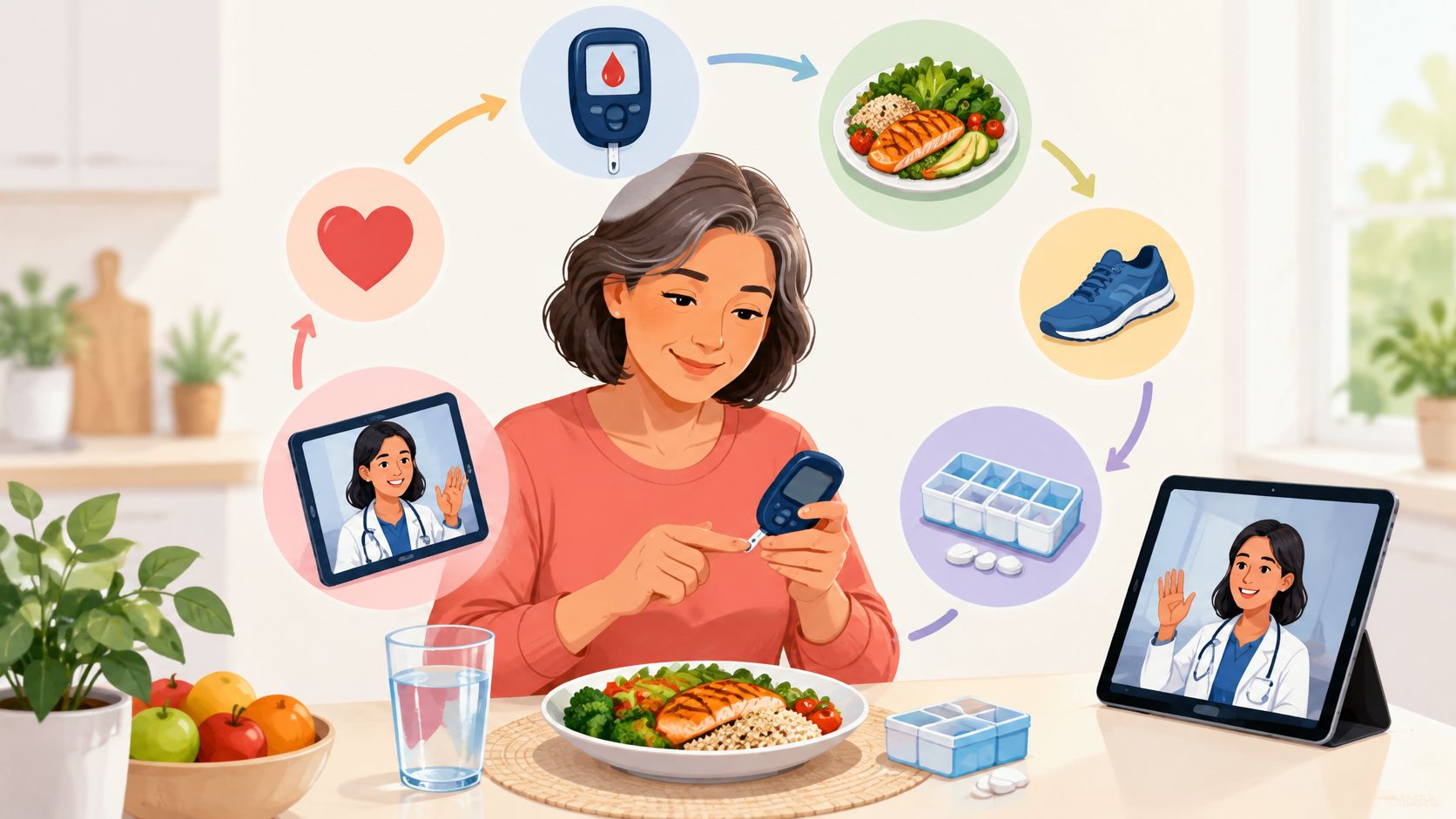
You're getting breakfast ready when your glucose reading is higher than you expected. You still need to take your prescribed medication, leave for work, and decide what to eat. By lunchtime, you may be wondering whether breakfast was the problem, whether a walk would help, or whether you should change something about your treatment.
Diabetes management works best when those decisions stay connected. Food, movement, medication, monitoring, and clinical care belong in the same conversation. The aim isn't to produce perfect numbers or perfect meals. It's to develop a routine you can sustain, recognize patterns, and know when you need help interpreting them.
Table of Contents
- How Diabetes Management Works in Daily Life
- Core Components of an Effective Care Plan
- Interpret Blood Glucose Monitoring Safely
- Build a Practical Diabetes Nutrition Routine
- How Life Primary Care Can Help
- Use Physical Activity as a Glucose Tool
- Use Prescribed Medication Without Guesswork
- Coordinate Routine Care and Complication Checks
- Know When to Seek Clinical Guidance
How Diabetes Management Works in Daily Life
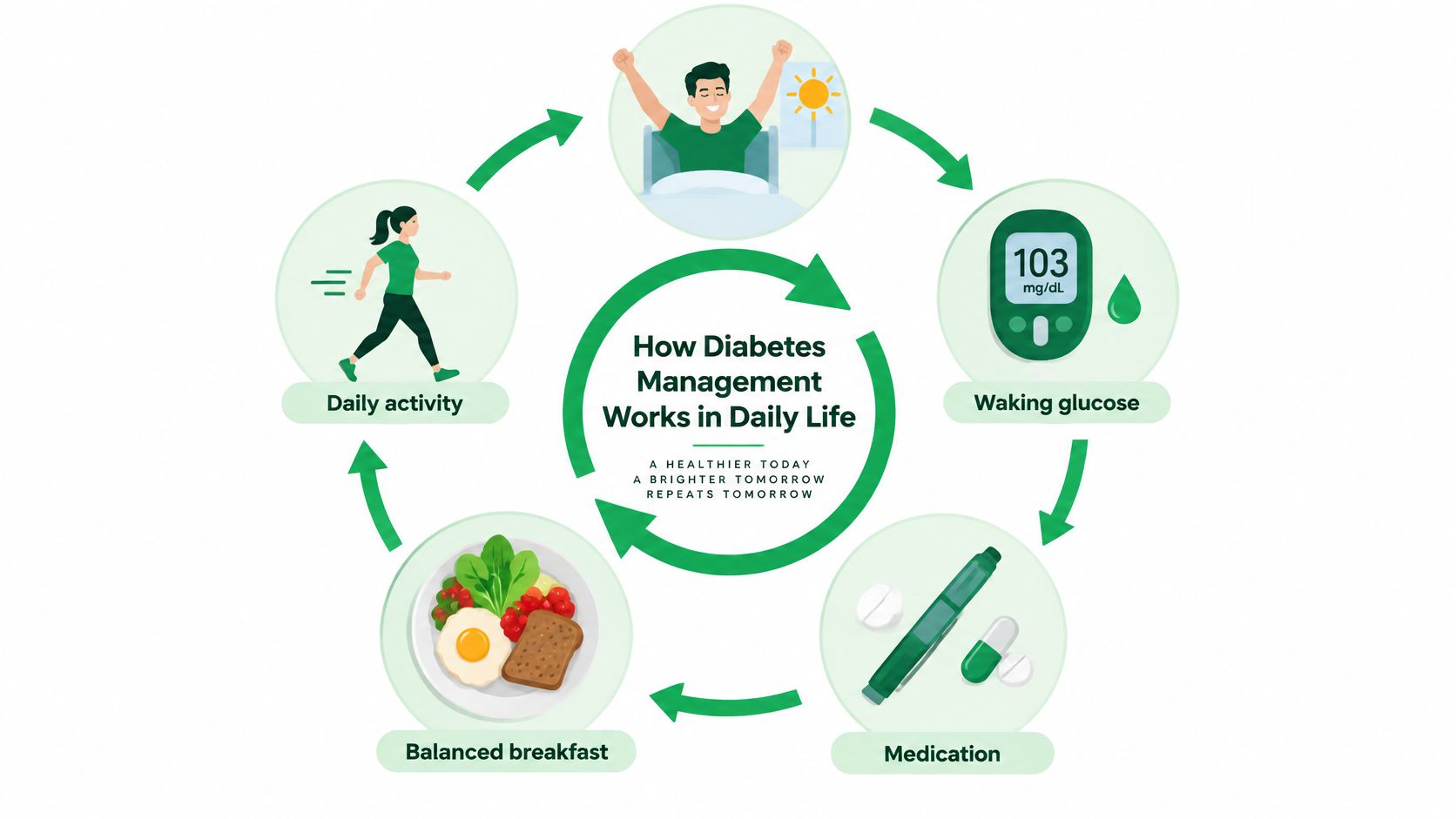
Consider a hypothetical morning. You wake up, check your glucose according to your care plan, and take your medication as prescribed. Breakfast is familiar, but your schedule isn't: you slept poorly, have a demanding workday ahead, and may eat lunch later than usual.
A reading without that context leaves important questions unanswered. Before deciding that breakfast needs changing, you and your care team may need to consider medication timing, sleep, activity, symptoms, and whether the same pattern has happened before.
The daily routine is easier to understand as a connected cycle.
Build a routine around your actual day
At work, you might record lunch, note an unusually active afternoon, and check glucose at the times your clinician recommends. An evening review then becomes a way to connect events, not judge yourself.
You don't need an elaborate diary. A notebook, meter history, or phone-based log can provide useful context if you can maintain it consistently.
- Monitoring records what your glucose is doing.
- Nutrition and movement describe important parts of your daily routine.
- Medication provides the treatment your clinician prescribed.
- Routine care and communication help your team interpret observations and plan follow-up.
If taking a meal photo is easier than entering foods manually, this guide to counting calories with AI food detection explains the approach. Keep the purpose clear: documenting a meal is different from determining treatment.
Treat readings as signals, not grades
Think of your records as a dashboard. A warning light tells you to investigate; it doesn't explain the cause by itself. Similarly, a glucose result can prompt a useful question without proving that you made a mistake.
Your dashboard won't look exactly like someone else's. Diagnosis, treatment, age, other health conditions, daily responsibilities, and agreed clinical goals all matter when creating an individual plan.
Practical rule: Record enough context to ask a better question, rather than trying to explain every reading immediately.
This guide is educational. It doesn't replace individualized care or authorize you to change treatment independently. Ask your care team to clarify your monitoring schedule, personal targets, and response plan so you're not making difficult decisions from general advice alone.
Core Components of an Effective Care Plan
A useful care plan assigns each task a distinct job. Otherwise, it's easy to expect a food diary to explain every glucose change or assume that a reassuring reading means all preventive care is complete.
Access matters, too. The World Health Organization reported that more than 800 million adults had diabetes in 2022, while nearly 450 million adults aged 30 and older weren't receiving glucose-lowering medication, illustrating how far diagnosis alone falls short of effective care (WHO overview of diabetes and treatment gaps).
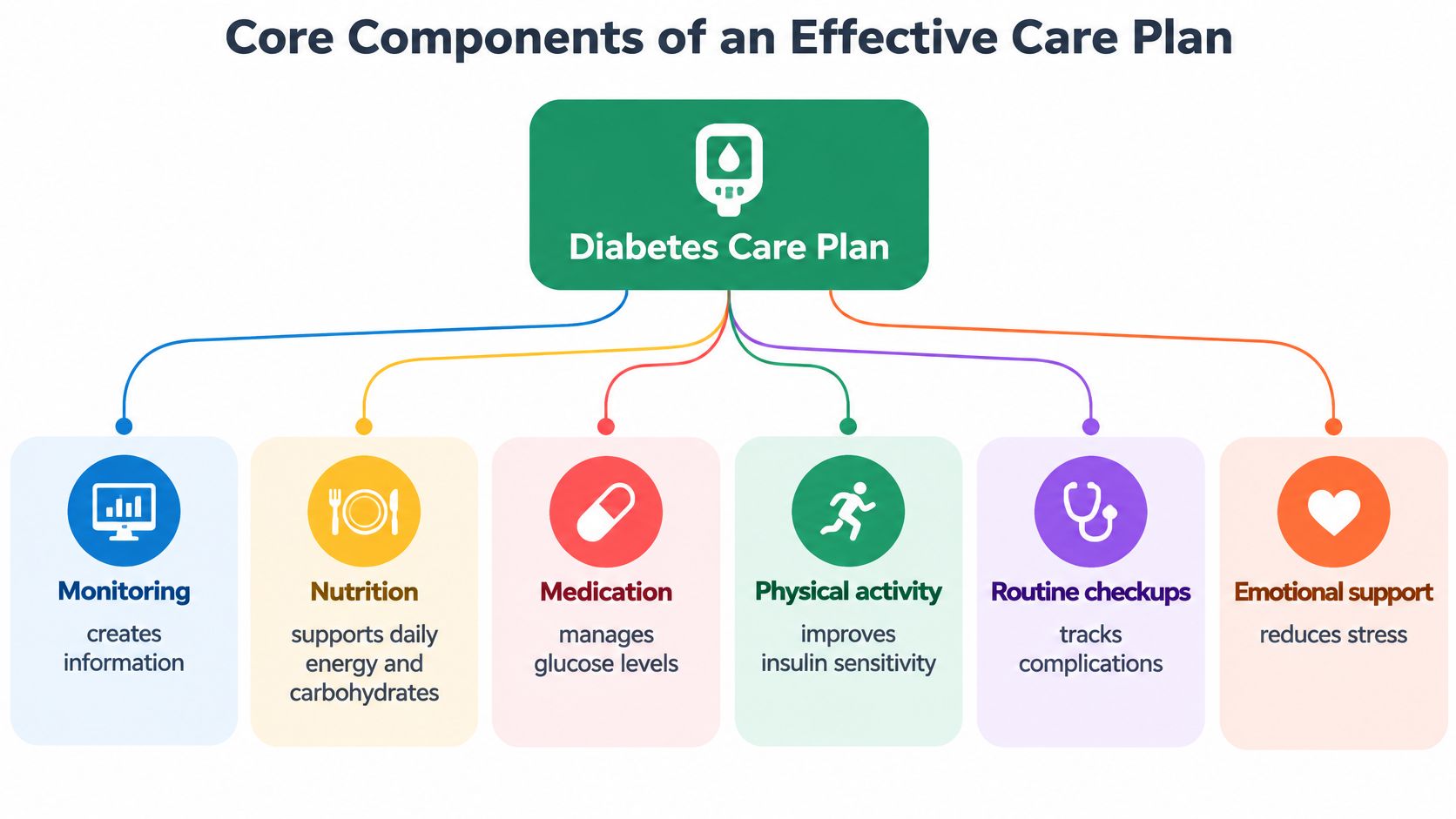
The components below belong together, but they aren't interchangeable.
Give each component a clear purpose
| Component | Its job in your plan |
|---|---|
| Monitoring | Provide information for review |
| Nutrition | Make eating workable within your health needs and circumstances |
| Physical activity | Establish a sustainable movement routine with appropriate safeguards |
| Medication | Deliver prescribed treatment consistently |
| Routine care | Assess longer-term health and complication risk |
| Clinical guidance | Turn observations into individualized decisions |
Emotional support belongs throughout this plan. If you're overwhelmed, ashamed of readings, or exhausted by daily decisions, tell your team. A technically detailed plan isn't practical if you can't manage its demands.
Planning tools also need the right scope. A discussion of AI meal planning and weight-management research may help you evaluate a nutrition tool, but a meal-planning feature isn't a substitute for diabetes-specific treatment guidance.
Why consistency matters over time
The strongest reason to build a sustainable routine is its long-term purpose. In the UK Prospective Diabetes Study, intensive glucose treatment reduced microvascular disease by 25% during the trial; later follow-up found lasting benefits even after the original glucose differences disappeared (Oxford's UKPDS trial summary).
That finding supports early, consistent care. It doesn't mean everyone should pursue the same target or that an individual should intensify medication without supervision.
For a complementary explanation of everyday management, the following video can support discussion with your care team.
Managing established diabetes and preventing diabetes are different clinical situations. Advice intended for someone at high risk shouldn't be used to replace treatment for someone already diagnosed. Ask which recommendations apply to your situation, particularly when reading about weight loss, carbohydrate restriction, or medication.
Interpret Blood Glucose Monitoring Safely
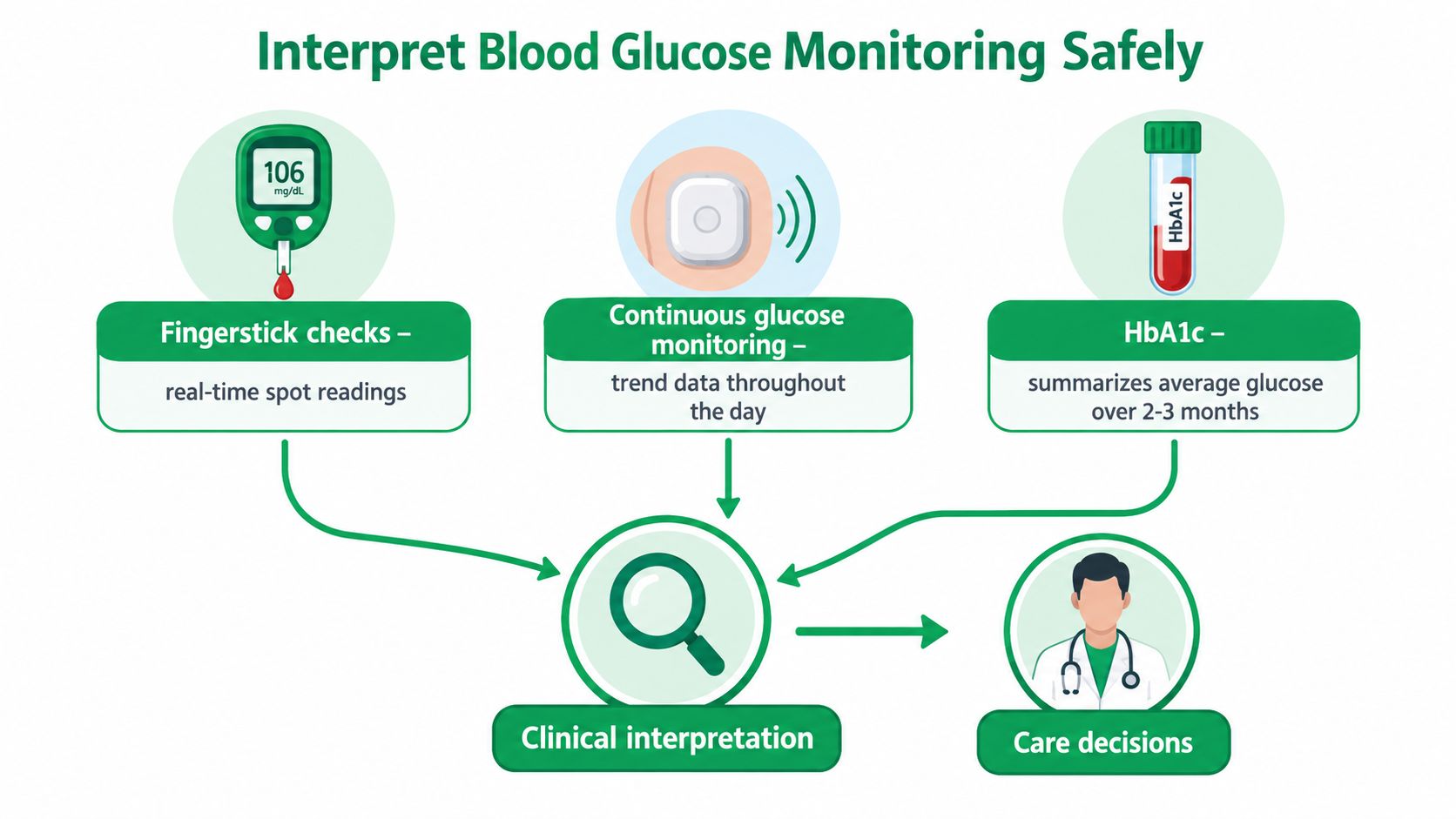
A fingerstick, a continuous glucose monitor, and an HbA1c result answer different questions. A fingerstick provides a spot reading. A continuous glucose monitor, usually shortened to CGM, helps reveal trends, while HbA1c summarizes longer-term glucose exposure.
The distinction matters because similar averages can conceal different daily experiences. A person's overall result may not explain whether they're having meal-related rises, overnight lows, or considerable variation.
The monitoring methods contribute different information to clinical interpretation.
Understand what time in range means
Time in range describes how much time glucose stays within a defined interval. A commonly used reference for most nonpregnant adults is 70–180 mg/dL, or 3.9–10.0 mmol/L, but that reference isn't an individualized prescription; CGM interpretation also considers time below range, time above range, and variability (clinical review of CGM metrics and interpretation).
Ask your clinician which measures matter most for you. Pregnancy, treatment-related risks, and other individual circumstances require a plan that goes beyond copying a range from an article.
Review patterns without chasing every change
Use a consistent review process rather than reacting differently to each unfamiliar result.
- Check the circumstances. Record when the reading occurred and whether you had symptoms.
- Add the relevant context. Note meals, prescribed medication timing, activity, sleep, illness, or unusual stress.
- Look for repetition. Compare similar situations before deciding that a particular food or activity caused the result.
- Separate observation from action. Write down your question, then use your agreed care plan to decide whether to monitor, contact the team, or seek urgent help.
For example, a rise after dinner becomes more informative if you can identify the meal, its timing, and what happened afterward. It still doesn't reveal the correct medication dose.
If a reading seems inconsistent with how you feel, follow your device instructions and your clinician's confirmation guidance. Don't dismiss symptoms because a display looks reassuring.
Technology should support questions and clinical conversations, not replace them.
Avoid turning monitoring into a restriction contest
Trying to make a graph look better can lead to unhelpful decisions. Skipping or delaying meals solely to remain in range is not the same as following a balanced treatment plan.
Evidence summarized in the clinical overview of diabetes monitoring and education emphasizes individualized support and describes meal-skipping behavior as a potential unintended consequence of simplistic glucose optimization. The practical lesson is to evaluate how you're using the information, not just whether you're collecting more of it.
Recurrent abnormal readings, suspected treatment problems, and medication changes require professional guidance. Keep your clinician's response instructions accessible, especially if you use treatment that carries a risk of low glucose.
Build a Practical Diabetes Nutrition Routine
Your family's rice dish, a sandwich eaten between meetings, and fruit shared after dinner all belong in a realistic nutrition conversation. A workable plan starts with what you eat, can afford, and know how to prepare.
Labeling foods as good or bad doesn't answer the questions people face at the table. More useful questions concern the portion, the rest of the meal, the eating schedule, and how the plan fits prescribed treatment.
Start with a familiar meal
Suppose dinner includes rice, lentils, vegetables, and a sauce prepared from a family recipe. Rather than deciding that the entire meal is unsuitable, describe its components and discuss which adjustments might preserve the meal's meaning while meeting your needs.
Bread and fruit deserve the same practical approach. Ask how they fit into your eating plan instead of assuming they must disappear. Your dietitian can help you consider portions, carbohydrate distribution, preferences, and food access together.
- Describe the usual serving. Include refills, drinks, sauces, and side dishes when relevant.
- Identify practical constraints. Work breaks, shared meals, cost, and cooking arrangements affect what you can sustain.
- Choose a manageable question. Ask about your usual breakfast or family dinner rather than trying to redesign everything at once.
Research on self-management barriers identifies cultural eating practices, occupational demands, healthcare access, medication difficulties, and emotional burden as important parts of the problem (research on barriers to culturally realistic diabetes self-management). Nutrition advice needs to address those circumstances, not just nutrient totals.
Use photo estimates as editable observations
A notebook, manual nutrition tracker, or photo-based tool can help document meals. What The Food is one option that estimates ingredients, portions, calories, and macronutrients from meal photos and provides meal history and trend views.
For the rice-and-lentil dinner, a photo estimate might assume a different serving size or miss an ingredient in the sauce. Correct the description where possible and use the serving adjuster to refine the portion assumption. If you can't resolve an uncertainty, record it rather than presenting the estimate as exact.
A comparison of AI tools for macro tracking by food group can help you consider different logging approaches. Choose the method you can review and correct, not the one that produces the most detailed-looking output.
Useful and misleading meal-tracking interpretations
| Situation | More useful interpretation | Misleading interpretation |
|---|---|---|
| A mixed dish has uncertain ingredients | Check the recipe and note what remains unknown | Assume the photo reveals every ingredient |
| The serving estimate looks wrong | Adjust it to better reflect what you ate | Accept it because the app supplied a number |
| Similar meals appear repeatedly | Review the pattern alongside your glucose records | Declare the food responsible for every rise |
| A smaller serving is being considered | Discuss how it fits your overall plan | Calculate a medication change from the estimate |
| A family meal is difficult to log | Use a reasonable description and acknowledge uncertainty | Stop recording because precision is impossible |
Finish a review by choosing a question worth discussing: Is the usual serving appropriate? Are long gaps between meals creating difficulties? Would a recipe adaptation be affordable and acceptable to the household?
A useful nutrition record supports understanding, not punishment. Portion changes should fit your clinical plan, and an app-generated carbohydrate estimate should never be treated as an independent insulin-dosing instruction.
How Life Primary Care Can Help
Getting to an appointment can become a major obstacle when you have mobility limitations, use oxygen, or depend on someone else for transportation. For people in those circumstances, home-based care may make diabetes follow-up more practical.
Life Primary Care is a house-call practice serving northern and central New Jersey. Its clinicians provide care where patients live, while the East Hanover coordination office handles scheduling, insurance verification, and follow-up rather than office-based patient visits.
The service uses an at-home care model.
When a home visit may be a useful fit
For someone struggling to attend regular appointments, in-home primary care for diabetes from Life Primary Care offers a way to discuss treatment, review medications, and arrange appropriate follow-up without traveling to a clinic.
The home setting also allows a clinician to see medication bottles and practical barriers firsthand. That may be particularly helpful after a hospital discharge, when new instructions need to be reconciled with the medicines already at home.
- Care coordination needs. The practice provides chronic disease care, medication reviews, and communication with involved specialists.
- Testing access. Services include in-home blood collection, urine testing, EKGs, and coordination of mobile imaging.
- Caregiver involvement. Home visits and phone-based results can make it easier to include relatives who help manage daily routines.
Questions to ask before arranging care
Confirm that your address is within the service area and that your insurance is accepted. Ask which diabetes services can occur at home, which require outside referrals, and how concerns between visits are handled.
Home primary care is particularly relevant when travel itself disrupts continuity. It doesn't eliminate the need for specialist assessment when indicated, and same-day non-emergency care shouldn't be confused with emergency response.
Use Physical Activity as a Glucose Tool
A planned walk and an unexpectedly demanding workday aren't equivalent experiences. During the walk, you may know when you'll start, when you last ate, and how to follow your monitoring plan. During a busy shift, you may be active for longer than expected while meals and breaks become less predictable.
A useful activity plan accounts for both. Movement belongs in diabetes management, but it shouldn't become a punishment for eating or an attempt to force a reading downward.
Compare activity in context
Consider the differences between a walk after a meal, resistance work, and a physically demanding day of errands. Each involves different effort, timing, and opportunities to eat, rest, or monitor.
Rather than assuming they'll produce the same response, discuss what you should watch for during and after each type of activity. Your team can help you interpret patterns and identify restrictions or precautions relevant to your treatment.
- Record the activity. Describe what you did, how long it lasted, and whether it was usual for you.
- Include the starting circumstances. Add meal timing, medication taken as directed, symptoms, and available glucose information.
- Note recovery. Record how you felt afterward and whether you noticed a recurring pattern.
- Bring a specific question. Ask what the pattern means for future activity planning.
The purpose isn't to prove that exercise always produces an immediate result. It's to build a routine that is practical and safe for your circumstances.
Keep prevention evidence in perspective
Structured lifestyle support has strong evidence in people at high risk of developing type 2 diabetes. In the NIH Diabetes Prevention Program, lifestyle intervention reduced diabetes incidence by 58% over approximately three years compared with placebo, but those findings concern prevention and shouldn't be presented as a replacement for treatment of established diabetes (NIDDK evidence supporting diabetes prevention).
That distinction helps avoid a common misunderstanding: needing medication doesn't mean your activity efforts have failed. Medication and movement can have different jobs within the same plan.
Safety boundary: Use your existing exercise and glucose-response instructions. Don't improvise medication changes to accommodate a workout.
If your job becomes more physical, your mobility changes, or you're starting an unfamiliar exercise routine, raise that change with your clinician. Ask what preparation, monitoring, and symptom response are appropriate.
Skipping meals or sharply restricting food to improve the apparent result of an activity session isn't balanced planning. Choose an activity routine you can repeat, and use your records to support a clinical conversation rather than a contest with your monitor.
Use Prescribed Medication Without Guesswork
A familiar meal produces an unfamiliar glucose pattern, and you wonder whether your medication needs changing. That's a reasonable question for your prescriber, but it isn't a question a meal log can answer on its own.
Prescribed medicines have different roles. Some plans include insulin, others include non-insulin treatment, and some also address blood pressure or cholesterol. Understanding why each medicine appears on your list is more useful than trying to interpret all prescriptions as responses to the latest glucose reading.
Make the prescription understandable
Ask your clinician or pharmacist to explain the purpose, timing, and relevant precautions for every medicine. You should also know whom to contact if you miss a dose, experience a possible side effect, or can't obtain a refill.
Keep those instructions with an up-to-date medication list. Include medicines prescribed by other clinicians, nonprescription products, and supplements so the person reviewing treatment has the full picture.
| Situation | Your daily responsibility | What needs professional review |
|---|---|---|
| Usual treatment day | Follow the prescribed instructions | Whether the overall regimen remains appropriate |
| Missed or uncertain dose | Use your written instructions or contact the pharmacist or prescriber | What to do when no clear instruction applies |
| Repeated glucose concern | Document the circumstances and follow your response plan | Whether treatment needs adjustment |
| Suspected side effect or interaction | Report symptoms and the complete medication list | Cause, urgency, and treatment options |
| Refill or cost problem | Raise the barrier before treatment runs out when possible | Access support or a prescribed alternative |
Use repeated meals to frame a better question
Suppose you record a similar breakfast on different days and notice a recurring concern afterward. Your notes can help the clinician ask about serving size, medication timing, activity, symptoms, and other changes.
They cannot establish the correct dose by themselves. A useful message describes what happened and asks for review; an unsafe response is independently adding, withholding, or rescheduling medication to match an app estimate.
- Report the obstacle clearly. Say whether the problem is cost, access, confusing instructions, forgetfulness, or an unwanted effect.
- Ask for a workable solution. A plan that conflicts with your daily schedule may need professional review.
- Confirm the instructions. Repeat the agreed plan back in your own words and keep it accessible.
Do not start, stop, skip, or change insulin or other glucose-lowering medication based on this guide or a nutrition app. Follow the prescribing clinician's instructions and emergency plan.
This boundary doesn't mean ignoring problems. It means bringing them to someone who can assess the treatment safely rather than trying to solve them through trial and error.
Coordinate Routine Care and Complication Checks
Daily records describe part of your health, not all of it. Even when your usual routine feels stable, ask what clinical checks remain due and who will arrange them.
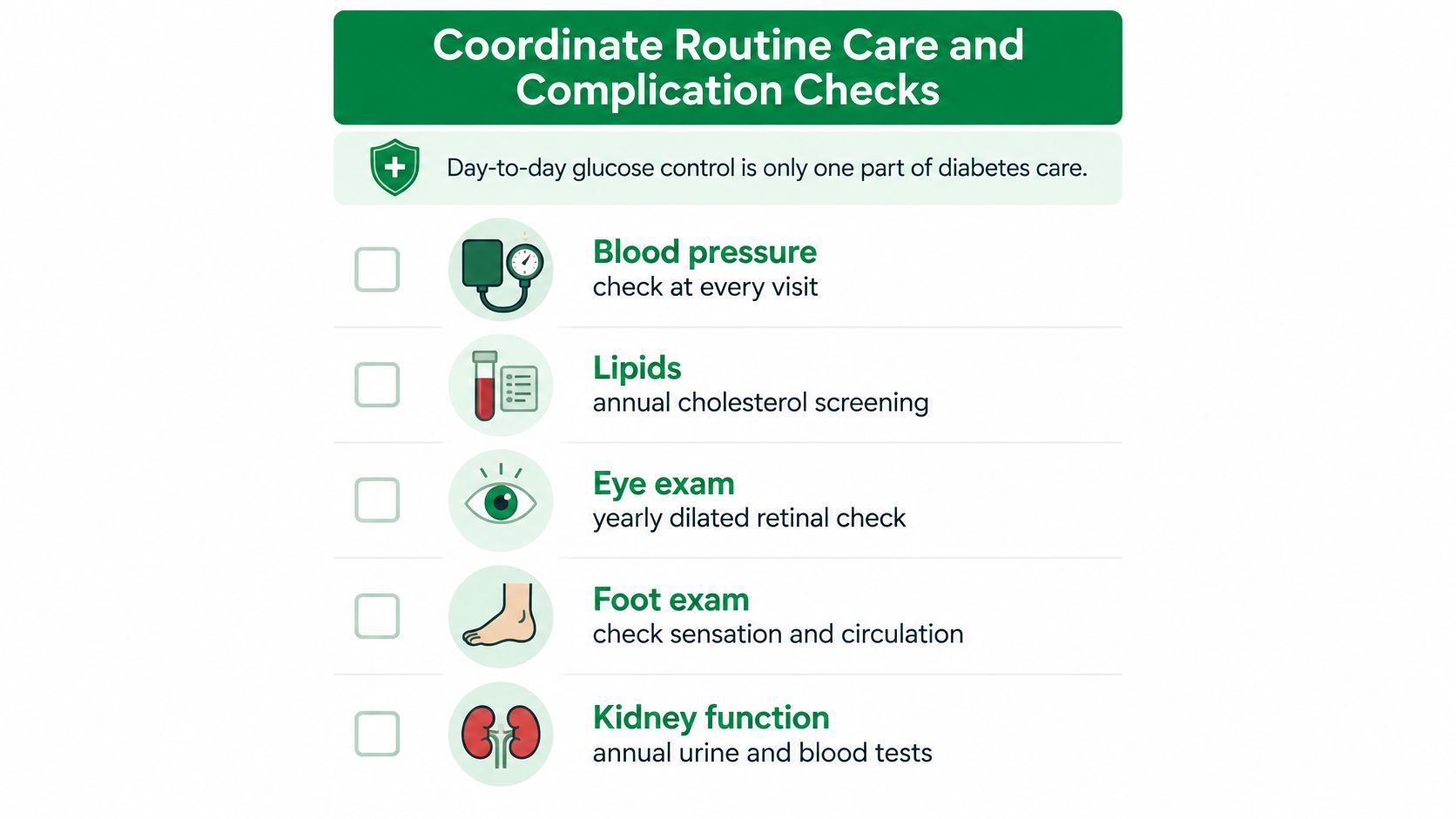
A plan may include blood pressure and lipid management alongside eye, kidney, and foot assessment. Ask your team how dental care, vaccinations, and other preventive services fit your individual needs.
Use the checklist as a conversation aid, not a universal appointment schedule.
Separate home observations from clinical assessment
Screening schedules should follow your clinician's recommendations. A general infographic cannot account for previous findings, symptoms, treatment, or changes in your health.
| Area | What you can bring from home | What the care team coordinates |
|---|---|---|
| Glucose | Readings, patterns, and symptoms | HbA1c review and treatment assessment |
| Cardiovascular health | Home measurements if requested and medication questions | Blood pressure, lipid, and broader risk review |
| Eye health | New visual concerns and previous appointment details | Appropriate eye assessment and follow-up |
| Kidney health | Questions about prior results or ordered tests | Testing, interpretation, and referrals when indicated |
| Foot health | New wounds, skin changes, pain, or altered sensation | Examination and appropriate treatment |
| Preventive care | Dental concerns and available vaccination records | An individualized preventive-care plan |
Not noticing a problem at home doesn't establish that screening is unnecessary. Ask which assessments apply to you and what preparation they require.
Prepare for an appointment with a short summary
A hypothetical appointment summary might describe a recurring afternoon pattern, meals and activity around it, medication questions, and the concern you most want addressed. A concise summary is often easier to discuss than an unfiltered collection of screenshots.
Bring your medication list and any relevant reports. If different clinicians are involved, ask who will receive results and who is responsible for explaining them.
- Prioritize the concern. Put symptoms or repeated treatment difficulties ahead of minor tracking questions.
- Identify unfinished follow-up. Mention an unbooked eye appointment, an unavailable test, or a referral you haven't heard about.
- Leave with ownership clarified. Know who orders the next test, who contacts you, and what you should do if no result arrives.
Access belongs in this conversation. Transportation, language, appointment availability, and affordability can determine whether a plan is feasible. Tell the team about those barriers and ask which alternatives are available instead of missing follow-up.
Know When to Seek Clinical Guidance
Some questions can wait for a planned review, such as help organizing meal records or understanding an established pattern without symptoms. Recurring highs, recurrent lows, suspected medication problems, or worsening foot or eye concerns deserve prompt professional assessment, following your care team's instructions.
For severe confusion, fainting, difficulty breathing, chest pain, or an inability to swallow safely, seek emergency help. Don't wait for an app result or routine callback, and follow your existing emergency plan.
Make your message useful
Provide dates, glucose values or CGM patterns, symptoms, meal and activity context, and medication timing as prescribed. State what changed and what guidance you need.
A meal record might identify a recurring eating pattern, while glucose records clarify its timing. Your clinician determines whether the appropriate response involves nutrition support, further assessment, or treatment adjustment.
Keep the loop connected
- Monitor as directed. Use your agreed targets and response instructions.
- Eat with a workable plan. Keep estimates separate from medical decisions.
- Move with appropriate safeguards. Discuss unfamiliar activity or changing limitations.
- Take medication as prescribed. Raise access problems and unclear instructions.
- Prepare for follow-up. Track outstanding appointments, tests, and questions.
- Escalate concerns. Use professional or emergency help when the situation requires it.
Choose a practical next step today: locate your written glucose-response plan, update your medication list, and write down the question you most need answered. Contact your diabetes care team if those instructions are missing or unclear. A useful daily routine should leave you better informed and supported, not responsible for making medical decisions from estimates alone.
Related Posts
Beginner's Guide to AI-Powered Macro Tracking
Estimate calories, protein, carbs, and fat from meal photos; fix portions and hidden fats, and track weekly trends with AI-assisted logging.
Manual vs AI Food Tracking: Which Method Works Better?
Manual tracking gives near-exact calories; AI photo logging is faster and boosts consistency—often a hybrid approach works best.
How Many Calories Are in a Slice of Pizza?
Typical cheese slice ≈285 kcal; slices range 170–700+. Size, crust, cheese, toppings and sodium drive the calorie difference.
Chicken, Eggs & Protein Foods: Calorie and Macro Breakdown
Calorie and macro breakdown of common protein foods to show which deliver the most protein per calorie.